









Ever opened Instagram or TikTok and felt like it just gets you? That’s not magic—it’s the algorithm.
A social media algorithm is basically a complex set of rules that decides what you see every time you refresh your feed. Think of it as your own personal content DJ, sifting through millions of posts to spin a playlist perfectly tuned to keep you scrolling. Its main job is to serve you the most relevant, timely, and engaging content based on your unique behavior.
What Is a Social Media Algorithm Anyway?

Imagine trying to find a good book in a library where millions of new ones arrive every single minute. It would be pure chaos. A social media algorithm is like a hyper-intuitive librarian who has watched you for weeks. It knows which authors you love, which genres you always pick up, and which topics make you stop and read the back cover.
Based on that, it sprints to the front of the line to hand you a book it knows you'll love. That’s exactly how a social media algorithm works; it cuts through the overwhelming noise to create a personalized experience. Without it, your feed would just be a messy, unfiltered firehose of every single post from every account you follow, all dumped in chronological order.
The Goal of Every Algorithm
At the end of the day, every algorithm has one main goal: to keep you on the platform for as long as possible. The more time you spend scrolling, the more ads you see, and that’s how these companies make their money. They do this by learning what makes you tick.
To build this custom-tailored feed, algorithms are constantly tracking signals. If you want to go deeper into the mechanics, it's worth exploring the truth about social media algorithms. These signals are the building blocks of everything you see:
- Your Relationships: It pushes content from friends, family, and accounts you interact with the most to the top.
- Your Interests: The algorithm learns the topics, creators, and even content formats you prefer based on every like, comment, and share.
- Content Relevance: It scans keywords, hashtags, and even visual cues in images to match posts with what it knows you’re interested in.
- Post Timeliness: Newer posts usually get a boost, but don't be surprised if a high-performing older post pops back up if it’s still getting tons of engagement.
The big shift happened when platforms moved from showing you "what's new" to showing you "what's new for you." This pivot from chronological to relevance-based feeds is the single most important concept to grasp.
Once you understand this, you can start making these powerful systems work for you, not against you. The trick isn't to fight the algorithm but to give it the high-quality content and clear engagement signals it’s designed to reward.
The Core Signals That Drive Every Algorithm
While every social media platform keeps its exact algorithm recipe under lock and key, they all shop for ingredients in the same aisle. Think of these core signals as the fundamental building blocks of content distribution. Platforms might mix them differently, but the underlying principles are universal.
Once you get a feel for these signals, you stop trying to "trick" the algorithm and start working with it. It’s not about finding loopholes; it’s about giving the system exactly what it’s designed to find and promote.
Engagement: Your Audience's Stamp of Approval
Engagement is, without a doubt, the most powerful signal you can send. Every like, comment, share, and save is a direct vote from your audience telling the algorithm, “Hey, this content is good.” It’s the digital version of a round of applause, and the platforms are always listening.
Imagine you're a comedian on stage. If the audience is silent, you'll probably wrap it up quickly. But if they're laughing, clapping, and telling their friends to listen, you're going to keep the show going. The algorithm sees your content the same way.
- Likes: The most basic nod of approval.
- Comments: A much stronger signal, as they take more effort and kickstart a conversation.
- Shares & Saves: This is the gold standard. A share means someone is willing to stake their own reputation on your content, while a save shows it has lasting value.
A flood of engagement, especially in the first hour after you post, is a massive green light for the algorithm. This initial buzz is often the trigger that pushes your content out to a much wider audience, well beyond your existing followers.
Relevance: The Perfect Content Matchmaker
At its core, the algorithm is a matchmaker. Its job is to connect the right piece of content with the right person at the right time. It’s constantly sifting through your posts for clues to figure out what they're about and who is most likely to care.
It does this by dissecting every element of your post to pin down its topic and theme. This is how the magic of discovery really happens.
The algorithm is constantly trying to answer one question for every user: "Out of everything I could show this person right now, what will they find most interesting?" Relevance is how it figures that out.
For instance, if you share a video titled "easy vegan recipes," the algorithm sees far more than just a clip. It’s analyzing:
- Keywords in your caption: It picks up on phrases like "vegan," "plant-based," and "healthy meals."
- Hashtags you use: #veganrecipes, #mealprep, and #easycooking all provide context.
- Visual and audio cues: Modern algorithms can even identify spoken words or objects on screen, like recognizing an avocado or a blender.
It then takes all that data and serves your video to users who’ve previously shown interest in vegan cooking, followed similar accounts, or searched for related hashtags. This is how a perfectly optimized post can suddenly take off with people who’ve never even heard of you.
User History and Relationships: The Personal Touch
This is where things get personal. The algorithm doesn't just evaluate your content on its own; it filters it through the lens of each individual user's past behavior. It’s the reason your feed feels like your feed and not just a random collection of popular posts.
This is exactly why that blurry photo of your best friend’s cat gets pride of place at the top of your feed, ranking higher than a slick, professionally produced video from a major brand. The algorithm knows you have a strong relationship with your friend because you constantly interact with their content.
The algorithm is always tracking:
- Past Interactions: Which accounts do you comment on and like the most?
- Time Spent: Do you tend to watch long videos all the way through or just scroll past them?
- Profile Visits: Are there certain profiles you find yourself checking in on regularly?
These patterns create a personalized hierarchy of importance. Content from people and brands you have a strong "relationship" with gets a serious leg up, making sure you don't miss the updates that matter most to you.
Recency: The Freshness Factor
Finally, there’s recency. No one wants to log into a feed full of stale, outdated news. Platforms want to show users what’s happening now, so new content almost always gets an initial boost to see if it can catch on.
But it’s not as simple as "newest is best" anymore. Today's algorithms perform a delicate balancing act. A brand-new post gets a chance in the spotlight, but if an older post from two days ago is still blowing up with comments and shares, it might easily outrank something posted just two minutes ago.
It's a constant trade-off between what’s new and what’s genuinely good.
How Each Major Platform Algorithm Is Different
Getting a handle on the core signals of social media algorithms is a great start, but it's really only half the battle. While every platform cares about engagement and relevance, they each have their own personality and priorities. Thinking every platform plays by the same rules is a huge mistake. It’s like assuming a chess grandmaster and a poker champion use the same strategy—sure, they both play games, but the path to victory couldn't be more different.
Understanding these platform-specific quirks is what separates generic, throwaway content from a social media strategy that actually works. Let's break down exactly what each of the big players wants to see from you.
The diagram below gives you a high-level look at the foundational signals that build your feed—things like engagement, relevance, and how recent a post is.
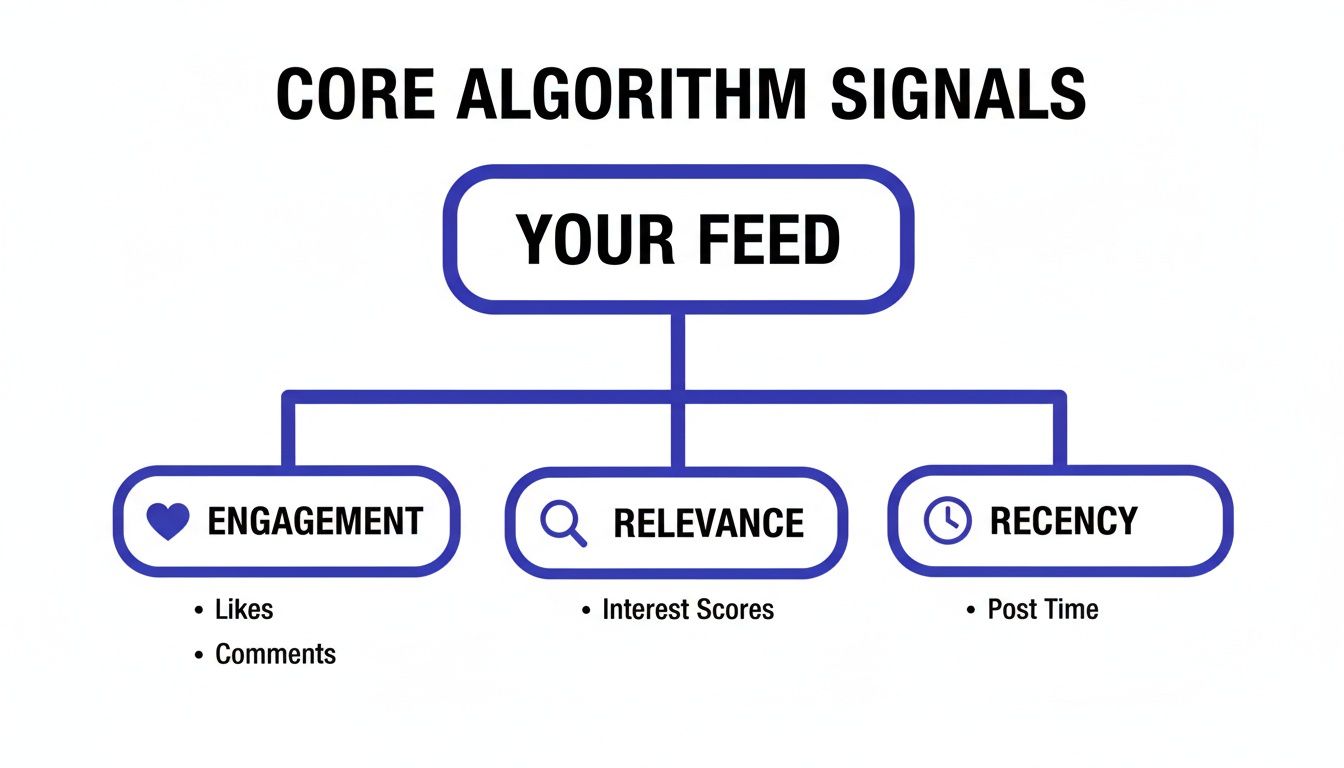
Think of these as the core pillars, but remember, each platform assigns a different weight to them, which is what creates such a distinct experience from one app to the next.
Instagram: A Tale of Two Feeds
Here's the first surprise: Instagram doesn't have one single algorithm; it has several. Each part of the app—the main Feed, Stories, Reels, and the Explore page—runs on its own set of rules, completely tailored to how you use that specific feature.
For your main Feed and Stories, the algorithm is all about showing you content from accounts you already know and love. It’s constantly looking at your history of likes, comments, and DMs to push posts from your closest connections right to the top.
Reels, though, are a completely different ballgame. The Reels algorithm is built for one thing: discovery. It prioritizes pure entertainment value above everything else, zeroing in on signals like:
- Watch time: Did someone watch your Reel all the way through?
- Audio usage: Is your Reel using a trending sound that people are saving and reusing?
- Engagement: Did the viewer like it, comment, or share it with a friend?
This is exactly why a Reel can explode overnight and reach millions of people who don't follow you, while a Story is mostly just seen by your existing audience.
Facebook: Prioritizing Meaningful Interactions
Facebook’s primary goal is to spark what it calls "Meaningful Interactions." In the platform's eyes, passive scrolling is far less valuable than active engagement that gets a real conversation going. This is why it heavily favors content from your friends, family, and any Groups you're active in.
On Facebook, a comment is worth way more than a simple like, and a long, thoughtful reply is even better. The algorithm is constantly trying to predict which posts will generate a genuine back-and-forth between users.
This focus on interaction explains why you often see posts with hundreds of comments but relatively few likes sitting at the very top of your feed. The algorithm sees that lively debate as a powerful signal that the content is compelling and valuable.
To win on Facebook, your goal shouldn't just be to get a reaction—it should be to start a conversation.
TikTok: The Ultimate Discovery Engine
The TikTok algorithm is legendary for its uncanny ability to make almost anyone go viral, follower count be damned. Unlike other platforms that lean heavily on your social graph (who you follow), TikTok's "For You" page (FYP) is almost entirely driven by how people react to the content itself.
It works like this: TikTok shows a new video to a small test group and measures their immediate reactions. The signals it cares about most are:
- Completion Rate: How many people watched the entire video? This is the single most powerful metric.
- Rewatches: Did users watch it more than once? Even better.
- Shares: Sharing a video with someone is a massive vote of confidence.
- Comments and Likes: These are still important, but they come second to watch-time metrics.
If a video performs well with that initial test audience, TikTok pushes it out to a larger group, and then a larger one, creating a powerful snowball effect. Your number of followers has almost zero impact on a video's initial reach.
YouTube: The Session Time King
YouTube's algorithm has one overarching obsession: session duration. Its main goal is to keep you on the platform for as long as humanly possible, watching one video after another. It does this by focusing on two key metrics that feed into each other.
First up is Click-Through Rate (CTR). Your video's title and thumbnail have to be compelling enough to make someone click when it shows up on their homepage or in the "Up Next" sidebar.
Once they click, the second metric kicks in: Average View Duration. The algorithm watches closely to see how long people stick around. A high view duration signals that your content delivered on the promise of its title and thumbnail, leaving the viewer satisfied.
Videos that nail both a high CTR and a long watch time are algorithmic gold. YouTube will then recommend that video to more and more people, creating a feedback loop that keeps users glued to the platform.
X (Formerly Twitter): The Real-Time News Ticker
The algorithm for X is built for one thing: speed. Its primary focus is on what’s happening right now. The "For You" timeline is a mix of tweets from accounts you follow, trending topics, and breaking news it thinks you’ll find interesting.
The key signals for the X algorithm are pretty straightforward:
- Recency: The fresher the tweet, the better its chances.
- Engagement: Replies are weighted more heavily than Retweets or Likes because they indicate a real conversation is happening.
- Topic Relevance: The algorithm analyzes the topics and keywords you engage with to surface similar content.
Unlike other platforms where a piece of content can have a long shelf life, the value of a tweet often decays in a matter of hours. Success on X is all about being part of the current conversation, in the moment.
Social Media Algorithm Ranking Factors: A Platform Comparison
To make sense of these differences, it helps to see them side-by-side. Each platform is essentially playing a different game with a unique set of rules.
| Platform | Primary Goal | Key Ranking Signals | Prioritized Content |
|---|---|---|---|
| Visual Inspiration & Connection | Interactions with accounts, content format, watch time (Reels) | High-quality visuals, entertaining Reels, content from close connections (Feed/Stories) | |
| Meaningful Interactions | Comments, shares, reactions from friends/family/groups | Content that sparks conversation, personal updates, and community-driven posts | |
| TikTok | Entertainment & Discovery | Video completion rate, rewatches, shares, comments | Short-form, entertaining, and trend-driven videos that hook viewers instantly |
| YouTube | Maximize Session Duration | Click-through rate (CTR), average view duration | Engaging, long-form videos with compelling titles and thumbnails |
| X (Twitter) | Real-Time Information & Conversation | Recency, replies, retweets, topic relevance | Timely news, trending topics, and content that joins current conversations |
As you can see, a one-size-fits-all approach is doomed to fail. A viral TikTok video is built very differently from a top-performing YouTube video, and what works on Facebook will likely fall flat on X. Tailoring your strategy to the specific DNA of each platform is absolutely essential.
Remember when your social media feed was simple? It was a straight line—the newest post was always at the top. This was the era of the chronological feed, and in the early days of Facebook and Twitter, it worked just fine.
Back then, you could actually keep up. You followed a handful of people, and scrolling through their updates was manageable. The entire system was built on one simple idea: show people what’s new.
But then social media exploded. Suddenly, we were all following hundreds, even thousands, of accounts. Our feeds turned into a firehose of content, making it impossible to see everything. That amazing photo your friend posted got buried under a flood of random updates from brands and acquaintances you barely knew.
Why the Old Way Stopped Working
The platforms had a huge problem on their hands. Users were missing the stuff they actually cared about, which led to frustration and, even worse, disengagement. The chronological feed treated every single post the same, whether it was a baby announcement from your sister or a complaint about the weather from someone you met once.
This created a frantic, timing-obsessed game for creators. To get seen, you had to post at the exact moment your audience was scrolling. It was an exhausting and often ineffective way to share content. The system was broken because it wasn't connecting people with what truly mattered to them anymore.
The real issue was that chronological feeds only answered, "What was just posted?" They completely ignored the more important question: "What would I find most interesting right now?" This shift in thinking changed absolutely everything.
Facebook Flips the Script with EdgeRank
Seeing the writing on the wall, platforms began tinkering with a totally different approach. What if, instead of ranking posts by time, they ranked them by relevance? This pivot from "what's new" to "what's new for you" was the birth of the modern algorithmic feed.
Facebook led the charge around 2011 with its first real algorithm, EdgeRank. Instead of just looking at a timestamp, EdgeRank analyzed a post's potential value to you based on a few key signals: how close you were to the creator (affinity), what type of content it was (weight), and how old the post was (time decay). It was a massive leap away from the one-size-fits-all feed. You can dive deeper into this industry-wide evolution with insights on how social media platforms changed their ranking systems.
Suddenly, a super-engaging photo from your best friend posted hours ago could show up before a less interesting text update from ten minutes ago. This was the first major step toward the hyper-personalized, engagement-driven feeds we all use today.
From Smart Feeds to Hyper-Personalization
EdgeRank was just the opening act. Every other platform soon followed, building their own complex systems designed to surface the most relevant and engaging content. This evolution eventually gave us the incredible discovery engines on platforms like TikTok, where the algorithm can make a video go viral based on pure entertainment value—not the creator's follower count.
Understanding this history is critical for anyone trying to build an audience today. The entire social media world shifted its focus from rewarding timeliness to rewarding engagement. Your content's success no longer just depends on when you post, but on how deeply it connects with your audience. While timing still matters—as we cover in our guide on the best times to post on social media—it’s now just one piece of a much bigger, more interesting puzzle.
Actionable Strategies to Master the Algorithm

Knowing the theory is one thing, but putting it into practice is where you'll see real results. Instead of trying to find some short-lived "hack" to game the system, the best approach is to simply align your strategy with what the algorithm wants to see: genuine, high-value engagement.
Think of it this way: you’re not trying to beat the algorithm; you’re trying to work with it. The focus has to shift from chasing vanity metrics to creating content that your audience actually cares about.
Create Content That Sparks Conversation
The golden rule of working with any algorithm is to create content that stops the scroll and starts a conversation. A passive "like" is a weak signal. A comment, share, or save? That’s a powerful signal telling the platform, "Hey, this is good stuff!"
Before you can get those signals, you need to understand how to improve social media engagement from the ground up. Your goal should be to create posts that practically beg for a response.
- Ask open-ended questions: Don't just make a statement. Ask your audience what they think or what their experience has been.
- Create educational carousels: Make something so useful that people feel an impulse to save it for later.
- Share relatable stories: Nothing gets shared faster than content that connects on an emotional level.
Remember, a post that gets 10 thoughtful comments is almost always more valuable in the algorithm's eyes than one that gets 100 passive likes.
Prioritize Consistency Over Sheer Frequency
One of the biggest myths out there is that you have to post constantly to stay relevant. The truth? Consistency is far more important than frequency.
It’s much better to post three high-quality, engaging pieces of content every week than to push out low-effort posts every single day. A steady, predictable rhythm builds momentum and teaches the algorithm that you're a reliable source of good content.
Key Takeaway: The algorithm rewards reliability. Find a posting schedule you can actually stick with while maintaining quality. You’ll build trust with both your audience and the platform itself.
This is one of the most important parts of building a smart content plan. We dive deeper into creating these kinds of reliable systems in our guide on social media best practices.
Diversify Your Content Formats
You can't put all your eggs in one basket. As we've seen, every platform has its favorites—Reels on Instagram, long-form video on YouTube, carousels on LinkedIn. A smart strategy uses a mix of formats to play to the strengths of each platform’s algorithm.
This isn’t just about variety for variety's sake. The platforms themselves are built to push certain types of content. That's why places with powerful algorithmic feeds, like TikTok, can boast average session lengths of around 52 minutes—they're serving up exactly the formats people want to see.
- Do this: Take one great idea and repurpose it. A single blog post can become a carousel, a Reel, a Story, and a thread.
- Not that: Don't just plaster the same static image across every platform and wonder why it's not working.
Test out different formats and watch your analytics to see what connects with your audience on each specific channel.
Foster a Genuine Community
At the end of the day, the most powerful strategy is to stop thinking of your followers as a number on a screen and start treating them like a community. The algorithm is designed to amplify human connection, so the more you create it, the more you'll be rewarded.
Reply to comments. Answer DMs. Engage with other people's posts. When you build a real community, your followers turn into advocates who naturally boost your content through their own interactions.
This two-way street sends the strongest possible signal to the algorithm: your account is a place where real conversations happen.
The Unseen Impact of Algorithmic Feeds
Algorithms do more than just tidy up your feed; they're powerful systems that actively shape our online world. They influence which conversations go viral, which creators make a living, and even how we see reality itself. When you pull back the curtain, you start to see just how much this technology steers our digital lives.
One of the biggest side effects we hear about is the creation of “filter bubbles.” The algorithm’s main job is to show you things it thinks you’ll like. But over time, that can shield you from different viewpoints, creating a personalized echo chamber where your own beliefs are just reflected back at you.
From Community to Marketplace
The game has completely changed for creators, too. Back in the good old days of chronological feeds, every single one of your followers had a fair shot at seeing your posts. Not anymore.
Today, creators are locked in a constant battle for the algorithm's attention. Dwindling organic reach has turned social media from a community space into a hyper-competitive marketplace. Success is no longer just about getting followers; it’s about pumping out content that consistently feeds the algorithm's hunger for engagement. To keep up, tracking your performance is non-negotiable, and our guide on social media analytics and reporting can show you how to measure what really moves the needle.
The Amplification Effect
There's another, more subtle consequence of a system built purely on engagement. Because algorithms are designed to maximize interaction at all costs, they often end up amplifying sensational or polarizing content over more balanced, thoughtful discussions.
Algorithmic change produces measurable behavioral and economic externalities. Studies show that politically polarizing or emotionally charged posts can receive 2–5 times the average engagement rate, leading ranking systems to surface such content more frequently.
Why does this happen? Simple: emotional content gets a reaction. A fiery comment, an angry emoji, a shocked share—it all counts as engagement in the algorithm's eyes. To dig deeper into this, you can discover insights on the evolution of Facebook's algorithm. Understanding this amplification effect is critical to seeing both the incredible power and the hidden pitfalls of social media algorithms.
Common Questions About Social Media Algorithms
Even after laying out the basics, there are always a few tricky questions that come up about how social media algorithms really work. Let's tackle some of the most common ones head-on.
Can I Just Reset My Algorithm?
Not with a magic button, unfortunately. But you can absolutely "retrain" it. The algorithm is constantly learning from you, so the best way to reshape your feed is to be more intentional with your actions.
It's a two-sided coin: you have to consistently engage with the stuff you want to see (liking, commenting, sharing) while actively telling the platform what you don't want.
For instance, you can:
- Hit the "Not Interested" or "Show Me Less of This" option on posts you dislike. It's a direct signal.
- Unfollow or mute accounts that just don't resonate with you anymore.
- Clear out your search history on platforms like TikTok and YouTube to give it a cleaner slate.
Do this consistently, and over time, the algorithm will catch on to your new preferences and start serving you better content.
Why Did My Reach Suddenly Drop?
First off, don't panic. A dip in reach is completely normal and rarely means you've been "shadowbanned." More often than not, the answer is much simpler. Maybe you posted at an odd time when your audience was offline, or you tried a new video style that didn't quite land. Sometimes, it's just a crowded day, and there's more competition for attention in the feed.
Think of the algorithm as a dynamic marketplace. Your content's value is always being weighed against everything else available at that exact moment. A post that gets decent engagement on a busy Tuesday might have been a viral hit on a quiet Sunday.
Instead of jumping to conclusions, dig into your analytics. Look for patterns before you assume the worst.
Are Hashtags Still a Thing?
Yes, they absolutely are, but their job has changed. In the past, it was all about jumping on a massive trending tag to go viral. Now, it's smarter to think of them as a form of "Social SEO."
Using a good mix of broad and niche-specific hashtags helps the algorithm understand exactly what your content is about and who it's for. This gets your post in front of people who are actively searching for your topic or exploring related content, creating a much more qualified connection.
Tired of the algorithm guesswork? PostSyncer gives you the tools to test what works, schedule for peak times, and track your performance so you can make smarter decisions. Stop fighting the algorithm and start working with it. Give our free trial a spin!