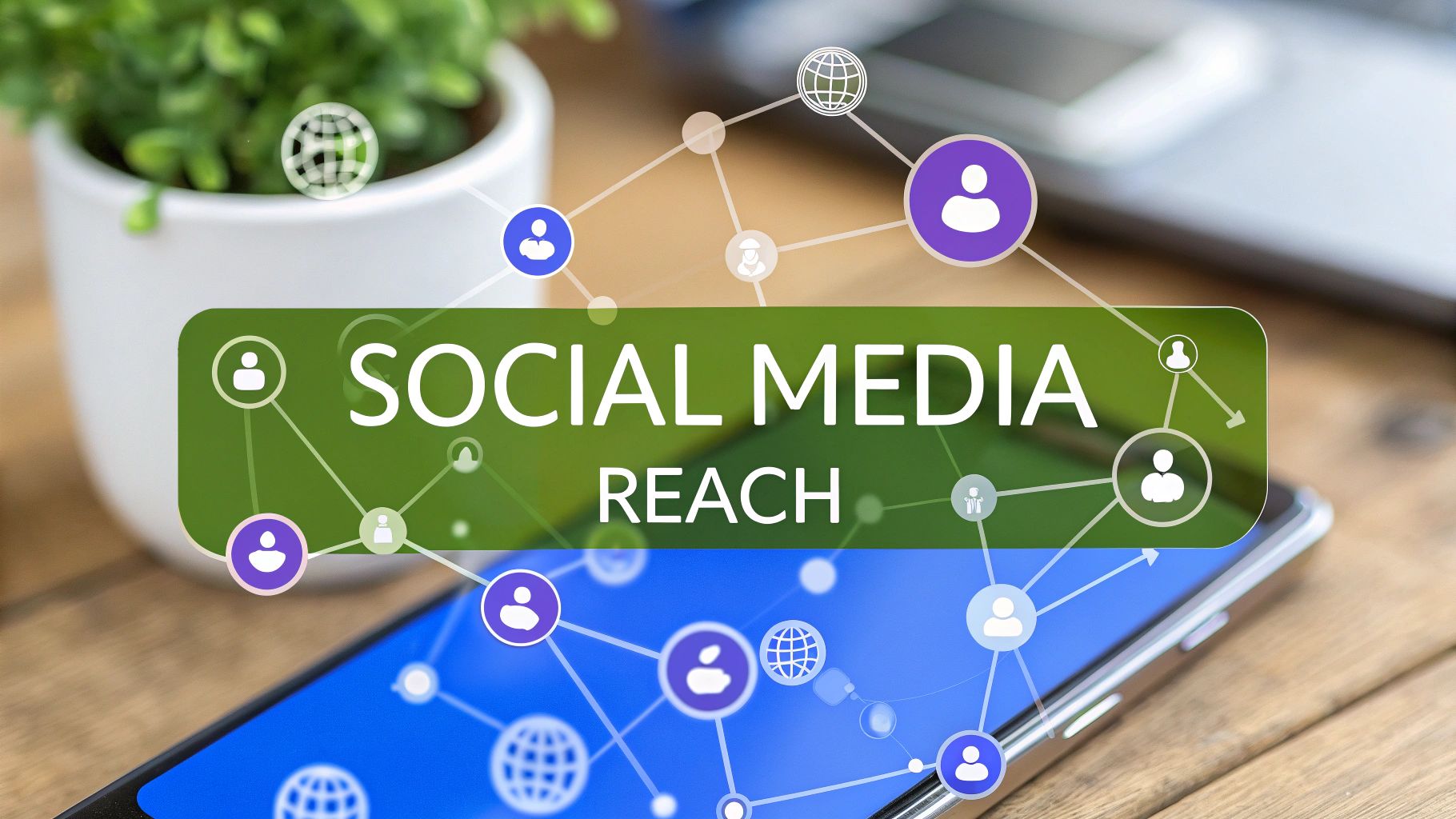








When you're trying to figure out if your social media is actually working, "reach" is one of the first words you'll hear. But what does it really mean?
In the simplest terms, reach is the total number of unique people who see your content. Think of it as a headcount. It’s not about how many times your post was seen, but how many individual sets of eyeballs saw it. Getting a handle on this is the first step to understanding the true size and impact of your audience.
Defining Your Social Media Footprint
Let's use a real-world analogy. Imagine you're handing out flyers in a busy town square.
If one person walks past your table three separate times and sees your flyer each time, you've generated three impressions. But your reach is still just one, because only a single, unique individual saw your message. This simple distinction is the bedrock of social media analytics.
Reach is all about the breadth of your audience. It answers the question, “How many different people did I actually connect with?” It’s a core metric for building brand awareness because it shows you how far your content is traveling beyond your immediate circle of followers. When you see your reach number climb, you know your content is successfully spreading to new people.
Why Reach Is a Foundational Metric
Understanding your reach is like getting a proper diagnosis from a doctor; without it, all the other numbers can be seriously misleading.
For example, sky-high engagement with rock-bottom reach tells you that you have a very passionate but tiny group of followers. On the flip side, massive reach with almost no engagement suggests your content is getting out there but isn't interesting enough to make anyone stop and interact. It's being seen, but it isn't resonating.
This is why tracking reach is so critical:
- Gauging Brand Awareness: It’s a direct measurement of how many unique users are becoming aware of who you are, what you sell, or what you have to say.
- Evaluating Content Spread: It shows you how well your content is being shared and, just as importantly, how much the platform's algorithm is pushing it to new audiences.
- Informing Ad Spend: When you're running paid campaigns, reach is one of the best indicators of how efficiently your budget is being used to capture the attention of your target audience.
At its core, social media reach isn't about how loud you're shouting. It's about how many different people are actually listening. It gives you a clean, unduplicated count of your audience, making it an honest measure of your content’s real-world visibility.
Ultimately, once you truly grasp what social media reach is, you can start building a much more effective strategy. It helps you set realistic goals, understand the real impact of your campaigns, and make smart, data-driven decisions to grow your online presence in a way that actually matters. It's the essential starting point for any deeper dive into your social media success.
Reach vs Impressions vs Engagement
To really get a grip on how your content is doing, you have to know the difference between three core metrics: reach, impressions, and engagement. They might sound like they're all in the same family, but each one tells a completely different part of your social media story.
I like to think of them as the "who," "how often," and "how well" of your analytics.
First up, reach is the who. It’s the straight-up count of unique, individual people who saw your post. If 100 different people laid eyes on your content, your reach is 100. Simple. It's a clean, unduplicated number that tells you the size of the audience you managed to capture with that specific post.
Next, impressions are the how often. This metric tallies the total number of times your content was displayed on a screen, period. It doesn't care if it's the same person seeing it over and over. If those 100 people from our example saw your post an average of three times each, you'd have 300 impressions. Because of this, your impressions will almost always be higher than your reach.
Getting a handle on these nuances is key. It's not just about reach; you also need to understand what are social media impressions and how they play together. For a deeper look at that specific metric, you can check out our detailed guide on social media impressions.
And finally, engagement is the how well. This tracks every action someone takes on your post—the likes, comments, shares, and clicks. It’s the ultimate proof that your content didn't just flash on a screen; it actually connected with someone and made them do something.
This little diagram helps visualize how these three metrics relate to one another. Reach is your unique audience, impressions are the total views that audience generates, and engagement is how they react.

As you can see, impressions can balloon without your reach growing, while engagement is a direct result of the audience you successfully reached in the first place.
To make this crystal clear, let's break down the core differences between these three fundamental metrics.
Reach vs Impressions vs Engagement at a Glance
| Metric | What It Measures | Primary Purpose |
|---|---|---|
| Reach | The total number of unique individuals who see your content. | Measures the size of your potential audience and brand awareness. |
| Impressions | The total number of times your content is displayed on-screen. | Gauges content visibility and frequency. |
| Engagement | The total number of interactions (likes, comments, shares). | Indicates audience interest and content quality. |
Each metric on its own offers a single data point, but when you look at them together, they tell a much richer story about what's working and what isn't.
Why This Distinction Matters
Knowing how these numbers relate is your secret weapon for diagnosing your content strategy. The combination of high or low metrics paints a picture and points you toward exactly what you need to fix.
Here’s what different scenarios are telling you:
- High Impressions, Low Reach: This is a classic sign that your content is being shown to the same small group of loyal followers over and over again. They're seeing it, but the algorithm isn't convinced it's good enough to show to new people.
- High Reach, Low Engagement: You've hit the jackpot with distribution—lots of people are seeing your post! The problem? It's not inspiring them to act. This usually means your message is too generic, your call-to-action is weak, or the content just isn't compelling enough to make them stop scrolling.
Looking at these metrics together gives you the complete picture. High reach means your distribution is on point. High engagement means your creative is hitting the mark. By keeping an eye on all three, you can move beyond just collecting data and start building an actionable plan for real growth.
The Different Types of Social Media Reach

When we talk about social media reach, it’s critical to understand that not all reach is the same. Your content can land in front of an audience through a few different pathways, and each one has its own role to play in a smart social media strategy.
Think of it like a storefront. Some people wander in because they live down the street and see your sign every day. Others show up after seeing an ad you placed in a local magazine. And then there are the ones who come rushing in because their friend couldn't stop raving about you.
Those are the three fundamental flavors of social media reach: organic, paid, and viral. A winning strategy doesn't just lean on one; it weaves all three together to drive real, sustainable growth. Let’s break down exactly what each one is and why it matters.
Earned Reach Through Your Community
Organic reach is the number of unique people who see your content naturally, without you spending a dime on promotion. This is your core audience—your followers and, by extension, some of their friends who might see your posts when they’re shared or liked.
This is the reach you earn. It’s a direct result of putting out quality content that resonates with the community you’ve built. It’s gotten tougher to achieve, for sure. On platforms like Instagram, organic reach saw a 12% YoY decrease, but it’s still the absolute bedrock of an authentic brand.
Organic reach is your brand's street cred. It's proof that your content is genuinely valuable—so valuable that the platform shows it to your followers without you having to pay for the privilege.
Bought Reach Through Advertising
Paid reach is exactly what it says on the tin: the audience you pay to get in front of. This is everything from boosting a post to running a highly specific ad campaign targeting certain demographics or interests. When you put money behind a post, you're buying a ticket to a bigger, more targeted audience.
This is your go-to tool for hitting specific business goals, like:
- Launching a new product and needing to make a big splash, fast.
- Targeting a super-niche audience that would be tough to find organically.
- Putting rocket fuel behind your best content to make sure it gets seen by as many people as possible.
Paid reach gives you control. It lets you sidestep the whims of the algorithm and guarantee your message lands where you want it to.
Exponential Reach Through Sharing
Last but not least, there’s viral reach. This is the rarest and most coveted of the three. It’s the number of unique people who see your content purely because other users are sharing it. Think of it as organic reach hitting the jackpot and multiplying exponentially.
This is what happens when a post is so funny, insightful, or shocking that it spreads like wildfire. Someone shares it, their friends share it, and then their friends share it, creating a massive snowball effect. It's the holy grail because it’s free, it’s driven by genuine enthusiasm, and it can introduce your brand to a colossal new audience almost overnight.
How to Measure and Report Your Reach
Knowing what social media reach is is one thing, but actually measuring it is where your strategy starts to take shape. This is the moment you move from theory to practice, figuring out exactly where to find the data and, more importantly, what to do with it. It’s how you turn those abstract numbers into real, actionable insights.

Every social media platform has its own native analytics dashboard, and this is your ground zero for reach metrics. Think of these tools as your single source of truth for understanding just how many unique people your content is touching.
Finding Your Reach Data
Thankfully, locating this crucial metric is pretty straightforward once you know where to click. Most platforms put it right in their main insights or analytics sections, making it easy to see how you’re doing over time.
Here's a quick rundown of where to look:
- Facebook & Instagram (Meta Business Suite): Head over to the "Insights" tab. You’ll find reach data for your page or profile as a whole, plus a breakdown for individual posts, Stories, and Reels.
- LinkedIn: On your Company Page, click into the "Analytics" tab. You can find reach under the "Updates" section, which shows you the unique viewers for every piece of content you share.
- X (formerly Twitter): From your account, go to the "Analytics" dashboard. The "Tweets" tab gives you a detailed look at impressions, which helps you track your reach trends.
Calculating Key Reach-Based KPIs
Just staring at a raw reach number won’t get you very far. To give that number meaning, you need to put it into context by calculating key performance indicators (KPIs) that measure it against your own audience size. The most important one here is your reach rate.
Reach Rate = (Post Reach / Total Followers) x 100
This simple formula turns your raw reach into a percentage, showing you what slice of your follower pie actually saw a specific post. It’s absolutely essential for comparing the performance of different posts on a level playing field.
After all, a post that reaches 2,000 people might sound great, but if you have 100,000 followers, that’s just a 2% reach rate. Context is everything.
This is exactly why that context is so vital when you're reporting to stakeholders. Instead of just throwing a number at them, you can tell a story. You can explain that, "Our latest campaign hit a 15% reach rate, blowing past our 10% benchmark and showing the algorithm is loving our content." For a deeper look at how to build these kinds of reports, check out our guide on social media analytics and reporting.
Reporting on Reach Effectively
Good reporting doesn’t just show the numbers; it explains what they actually mean for the business. As you track your reach over time, you’re not just watching a metric go up or down—you're gathering intelligence.
Your reports need to highlight trends and tie them directly back to your strategy. Are certain types of content always getting a higher reach rate? Did your reach take a nosedive after you changed your posting schedule? These are the kinds of insights that prove your efforts are working and guide what you do next, showing the real, tangible value of your work on social media.
Actionable Strategies to Increase Your Social Media Reach
Alright, now that you know how to read the map, it's time to start driving. Understanding your social media reach is the first step, but growing it is where the magic happens.
Expanding your audience isn't about throwing content at the wall and hoping it sticks. It requires a smart mix of organic tactics that build a real community and paid strategies that get you in front of the right people, guaranteed.
Let's break down the proven, no-fluff steps you can take to make sure your message travels further and connects with more people.
Cultivating Organic Growth
Organic reach is the bedrock of a healthy social media presence. Why? Because it’s earned, not bought.
These strategies are all about creating genuine value, sparking conversations, and making your content so good that the algorithms want to show it to more people.
Here are three powerful ways to boost your organic footprint:
Optimize Your Posting Times: Don't just post when it’s convenient for you. Dive into your platform's analytics to see exactly when your followers are online and scrolling. Hitting them during these peak hours gives your content the best possible start, encouraging those initial likes and shares that signal to the algorithm, "Hey, this is good stuff!"
Embrace User-Generated Content (UGC): Featuring content from your actual customers is one of the most powerful and authentic ways to grow. When you share a customer’s photo or rave review, it acts as incredible social proof. Even better, it encourages that person and their friends to share and engage, amplifying your message to a whole new network.
Master the Art of Hashtags: Think of hashtags as search terms for social media. Using a smart mix of broad, niche, and branded hashtags helps categorize your content so it can be discovered by people who don't even follow you yet. A solid hashtag strategy is like putting up signposts that lead new audiences right to your doorstep. For a deep dive, check out our guide on how to find trending hashtags to really maximize your visibility.
Another fantastic way to get in front of more people is by streaming to multiple platforms simultaneously. This lets you tap into different communities across several channels, all from a single piece of live content.
Leveraging Paid Advertising for Guaranteed Exposure
While organic growth is essential for building a loyal community, paid strategies give you the control and scale to hit specific business goals—fast. The numbers don't lie. In 2024, social media ad spending is projected to hit a massive $247.3 billion, a 14.3% jump from the previous year.
Why are businesses investing so much? Because it works. 80% of marketers use it for brand exposure, 73% for driving traffic, and 65% for generating leads.
Paid advertising is your shortcut to a guaranteed audience. It lets you bypass algorithmic uncertainty and place your content directly in front of the precise demographic you want to attract.
Here’s how to put your ad dollars to work effectively:
Run Targeted Awareness Campaigns: Forget just clicking the "Boost Post" button. Go into your platform’s ad manager and create dedicated campaigns with "Reach" or "Brand Awareness" as your objective. Facebook and Instagram will then do the heavy lifting, optimizing your ad delivery to show your content to the most unique users in your target audience for the lowest possible cost.
Strategically Boost High-Performing Organic Posts: This is my favorite trick. Scroll through your feed and find the organic posts that are already crushing it—the ones with the best engagement and natural reach. By putting a small budget behind these proven winners, you’re not just promoting a post; you're amplifying content that you know resonates with people. It’s a cost-effective way to get your best work the massive audience it deserves.
Still Have Questions About Social Media Reach?
Even after you've got the basics down, you're bound to run into some head-scratchers when you're in the trenches managing social media. This section is all about tackling those real-world questions that pop up every day. Let's get you some quick, clear answers.
What Is a Good Reach Rate, Really?
I wish I could give you a single magic number, but "good" really depends on the platform, your industry, and your audience. It's a moving target. That said, we can look at some general benchmarks to get a feel for what's working.
- On Instagram: Hitting an 8% reach rate for a feed post is pretty solid. For Stories, anything around 1% is often considered strong, especially as your account grows.
- On Facebook: With its notoriously tricky algorithm, a good organic reach rate is often somewhere in the neighborhood of 6%.
Remember, these are just ballpark figures. A small account with a super-engaged community might blow these numbers out of the water, while a huge global brand might see lower percentages.
Here's the most important benchmark: your own. Start tracking your reach rate over time. That will tell you what's normal for your account. A sudden spike or dip in your own numbers is way more meaningful than comparing yourself to some global average.
Help! Why Did My Reach Suddenly Drop?
It’s a heart-sinking moment for any social media manager, but a sudden drop in reach is usually caused by a few common culprits. The number one suspect? An algorithm change. Platforms are constantly tinkering behind the scenes, and these updates can torpedo your visibility overnight without any warning.
Another likely reason is simple content fatigue. If you’ve been posting the same style of content over and over, your audience might just be scrolling right past it. This signals to the algorithm that your stuff isn't hitting the mark anymore, so it starts showing it to fewer people. The fix is to keep things fresh—mix up your formats, try new topics, and keep your audience on their toes.
Why Are My Impressions Always Higher Than My Reach?
This is one of the most common points of confusion, but it's not just normal—it's guaranteed. It all goes back to the core definitions: reach counts unique people, while impressions count total views.
Think of it this way: if one loyal fan sees your post three different times, that’s one person reached but three impressions.
This gap isn't a problem; it's an insight. A big difference between your impressions and reach often means you have a dedicated core audience seeing your content multiple times. That's great for loyalty! But it also might mean you're not breaking out to new eyeballs. With over 5.4 billion active social media users globally as of 2025—that's about 68.5% of the world's population—there's a massive audience out there waiting. You can see more stats on global social media use on Backlinko.com.
Ready to stop guessing and start growing your reach with precision? PostSyncer provides the analytics and scheduling tools you need to understand your audience and optimize your content strategy. Start your 7-day free trial today and see what data-driven decisions can do for your brand.