










Think about the best piece of content you ever created. Maybe it was a deep-dive blog post, a killer webinar, or an insightful video that took you hours—maybe even days—to perfect. You hit publish, got a nice little spike in traffic, and then… moved on to the next thing.
What if you could take that one great idea and give it a dozen different lives? That’s the magic of content repurposing. It’s the art of taking a single, high-value asset and smartly reshaping it into multiple formats for different platforms and audiences.
It’s the ultimate marketing multiplier, letting you squeeze every last drop of value from your best work without having to constantly reinvent the wheel.
The Secret to Working Smarter, Not Harder in Marketing

Let's use an analogy. Imagine you’re a chef who spends all day crafting an incredible gourmet meal. You serve one plate, and then you toss the rest in the bin. Sounds insane, right? All that effort for a single serving.
That’s exactly what most marketers do with their content. They pour blood, sweat, and resources into one great piece, publish it once, and then let it fade into the archives. Content repurposing is the strategy that stops this waste. It’s about taking that one gourmet meal and turning it into a week's worth of delicious, unique dishes.
Redefining Your Content Workflow
A common mistake is thinking repurposing just means copying and pasting the same text everywhere. It's so much more than that. True repurposing is a strategic transformation—it's about breaking down your best content into its core ideas and then rebuilding them into new formats that feel native to different channels.
When you get this right, the benefits are huge:
- You reach more people. The folks who love your in-depth blog posts might not be the same ones scrolling through Instagram Reels or listening to podcasts. Repurposing lets you meet new audiences where they already are.
- You work more efficiently. Instead of being trapped on the content hamster wheel, always chasing the next new idea, you get more mileage out of the home runs you've already hit. This frees you up to focus on quality and promotion.
- You build real authority. Seeing your expertise pop up in different formats—as a blog, a video, a tweetstorm, an infographic—cements your credibility. It hammers home your key messages and makes your brand unforgettable.
Content repurposing isn’t about creating more content. It's about getting more results from the content you already have. It’s the difference between being busy and being productive.
This isn't just a niche tactic anymore; it's a core marketing discipline. The global content repurposing market was valued at $3.9 billion in 2025 and is on track to hit $7.8 billion by 2033. This boom shows just how many businesses are catching on and using smart tools like PostSyncer to make their content work harder for them.
To help you get started, here's a quick look at the core principles of content repurposing.
Quick Guide to Content Repurposing
| Concept | Primary Goal | Key Benefit | Example |
|---|---|---|---|
| Asset Transformation | Adapt one core idea for multiple platforms. | Expanded audience reach. | Turn a blog post into a podcast episode. |
| Format Adaptation | Change the delivery method of the content. | Cater to different learning styles. | Convert webinar slides into an infographic. |
| Audience Targeting | Tailor content for a specific channel's users. | Increased engagement and relevance. | Create short video clips from a long-form interview for TikTok. |
This table should give you a clear, at-a-glance understanding of how this strategy works in practice.
From One Idea to Many Assets
Ultimately, content repurposing is about embracing efficiency. For a deeper look at optimizing your entire workflow, check out this fantastic guide to working smarter, not harder.
By shifting your mindset, you can build a sustainable content engine that fuels your growth without burning you out. The trick is to see every piece of content not as a finished product, but as raw material for your next great idea. And if you're looking to put this on autopilot, it's worth exploring the world of social media automation.
Why Content Repurposing Is a Non-Negotiable Strategy
Knowing what content repurposing is is one thing. But the real "aha!" moment comes when you understand why it's a complete game-changer for any serious marketing effort.
Put simply, it's the smartest way to get more mileage out of your best ideas without doubling your workload. Think of it as an investment strategy for your content—you create one killer asset, then let it pay dividends across your entire marketing portfolio.
This isn’t about cutting corners. It's a calculated move to get your message heard louder and wider, cement your brand as an authority, and give your SEO a serious boost. When you stop seeing a piece of content as a one-and-done deal and start seeing it as a launchpad, you build a growth engine that actually lasts.
Reach New Audiences on Their Turf
Let's be real: not everyone hangs out in the same digital corners, and they definitely don't all consume content the same way. The person who loves your deep-dive, 3,000-word blog post is probably not the same person scrolling through 60-second Instagram Reels or tuning into a podcast on their commute.
If you’re only publishing in one format, you're missing out on huge chunks of your potential audience.
Content repurposing is your ticket into these other communities. It lets you meet people where they already are, speaking their language.
- For the Visual Crowd: That in-depth article can become a sharp-looking infographic or a deck of quote graphics perfect for Pinterest and Instagram.
- For the Listeners: A recorded webinar or interview is practically begging to be turned into a podcast episode for Spotify and Apple Podcasts.
- For the Busy Scrollers: A long-form guide can be chopped into a punchy Twitter thread or a slick LinkedIn carousel that delivers the key takeaways in seconds.
Each new format opens another door for someone new to find you. You're just maximizing your chances of making a connection with the right person, at the right time, on the platform they actually enjoy using.
"Repurposing content isn't about being lazy; it's about being strategic. You're ensuring your best insights get the visibility and engagement they deserve by adapting them for every possible consumption habit."
Understanding how this fits into your overall comprehensive content marketing strategy is what makes it so powerful. It’s the engine that takes your core message and broadcasts it far and wide, making sure your brand sounds consistent and valuable everywhere.
Strengthen Your SEO and Topical Authority
Search engines like Google love to see brands that know their stuff. When you create a whole ecosystem of content around a single core topic, you're sending a massive signal to the algorithms that you're the go-to source for that subject. This is what we call topical authority.
Repurposing is one of the most natural ways to build it. A single pillar post—like an ultimate guide—can spawn dozens of smaller assets that all link back to the main piece.
For example:
- Pillar Post: "The Ultimate Guide to Organic Gardening"
- Repurposed Video: "5 Common Organic Gardening Mistakes to Avoid" (which you then embed in the original post)
- Repurposed Infographic: "Seasonal Planting Calendar for Your Garden" (shared on social, linking back)
- Repurposed Blog Post: "How to Pick the Best Organic Soil for Your Veggies" (another internal link back)
This web of related content creates a powerful internal linking structure and pulls in backlinks from all over, all reinforcing your expertise in "organic gardening." The payoff? Higher rankings for the keywords that actually matter to your business.
Maximize Your Marketing ROI
Let’s talk money. Creating great content takes time, skill, and budget. The financial case for repurposing is probably its most convincing benefit. Instead of the old one-to-one model (one effort = one piece of content), you're shifting to a one-to-many model.
One high-effort pillar article can easily fuel your content calendar for weeks, if not months.
This isn’t just a nice-to-have; it's essential for keeping up. The global content marketing market ballooned from $36.8 billion in 2018 to over $413.3 billion by 2022. A huge part of that is because digital's share of ad spend climbed to 73.3% in 2022. Repurposing is how you meet that insane demand for fresh content across all those channels without burning through your entire budget.
By turning one asset into ten, you slash your cost-per-piece and make every single marketing dollar work that much harder for you.
Alright, you've grasped the "why" behind content repurposing. Now, let's get our hands dirty with the "how." This is where the real magic happens—turning one solid piece of work into a full-blown, multi-channel campaign that keeps on giving.
Think of this as your recipe book. We're going to break down the most common and powerful ways to transform your core content. No more letting that brilliant blog post or killer webinar collect digital dust.
From Blog Post to Everywhere
A well-researched, high-performing blog post is one of the most versatile assets in your content arsenal. It’s already packed with structured ideas, valuable insights, and juicy data points, making it the perfect starting point.
Here’s how to slice and dice it:
To an Infographic: Pull out the most compelling stats, data points, and key steps from your post. Use a simple tool like Canva or work with a designer to spin them into a visually striking infographic. This makes complex info super easy to digest and is prime material for sharing on Pinterest or getting picked up by other blogs for backlinks.
To a Social Media Carousel: Break down the blog's main arguments into 5-7 powerful takeaway points. Each point gets its own slide in a LinkedIn or Instagram carousel. Start with a hook-worthy headline on slide one and end with a clear call-to-action on the last slide, pointing people to the link in your bio for the full story.
To a Video Script: You've basically already written the script. Your blog's main headings are the perfect talking points for a short YouTube video or a series of snappy Instagram Reels. You can either get in front of the camera yourself or create a simple animated video to bring the ideas to life.
To a Twitter Thread: Boil down the article's core message into a string of punchy tweets. Grab their attention with a strong hook in the first tweet, use emojis to add some personality, and always, always link back to the original blog post at the end for those who want to go deeper.
This is all about giving your audience more ways to find and consume your best ideas, which expands your reach, boosts your credibility, and maximizes your original investment.
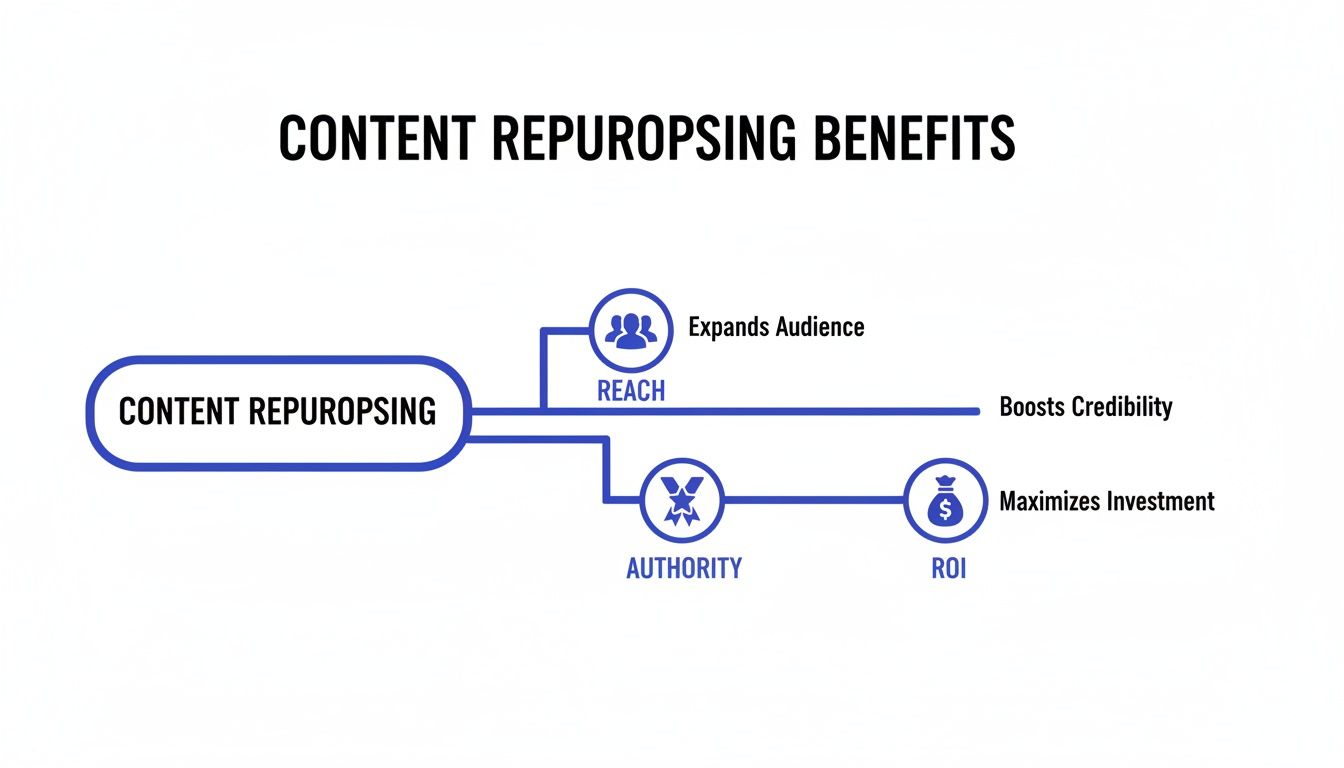
As you can see, every new format you create acts as another doorway into your brand's world, strengthening your presence everywhere your audience hangs out.
From Webinar to Widespread Buzz
Webinars are absolute goldmines of expertise, but their value shouldn't evaporate the second the live stream ends. That recording isn't the finish line; it's the starting gun.
Repurposing a webinar is about honoring the effort that went into it. You've already gathered the experts and the insights; now it's time to make sure that value reaches far beyond the initial attendees.
To a Blog Post Series: Don't just dump the transcript into a single, massive post. Instead, divide the webinar into its natural themes or sections. Each theme becomes its own dedicated blog post, complete with embedded video clips from that specific part of the webinar. This approach helps you build topical authority and gives you multiple new assets for SEO.
To Quote Graphics: Hunt for the most insightful, memorable, and tweetable quotes from your speakers. Turn them into sharp, branded graphics that are perfect for sharing on LinkedIn, Instagram, and Twitter. Make sure to tag the speaker—it encourages them to share with their own network, which is a huge win for your reach.
To Short Video Clips: Scrub through the recording and pull out the best 1-2 minute nuggets of wisdom. These could be killer answers to audience questions, a surprising statistic, or a super actionable tip. These clips are tailor-made for YouTube Shorts, Instagram Reels, and TikTok, introducing your expertise to a whole new audience.
From Podcast to Visual Engagement
An audio-only format like a podcast might seem restrictive, but it’s loaded with moments just waiting for a visual makeover. Nailing your content creation workflow is what makes this process smooth instead of a struggle.
To Audiograms: Use a tool to pair a short, can't-miss audio clip from your episode with a branded image and an animated soundwave. These audiograms are incredibly shareable on social media and act as a perfect teaser to get people to listen to the whole episode.
To a "Best Of" Blog Post: Get the episode transcribed and use that text as the foundation for a detailed blog post. Give it a clear structure with headings, pull out key quotes into blockquotes, and embed the full podcast episode right at the top. Suddenly, your audio-only content is now discoverable by search engines.
To Key Takeaway Graphics: Similar to quote graphics, identify the main lessons or actionable advice shared in the episode. List these takeaways on a clean, visually appealing graphic. You can share it as a standalone post on Instagram or as part of a carousel that neatly summarizes why someone should listen.
Content Repurposing Pathways At a Glance
To bring it all together, here's a quick cheat sheet showing how a single piece of content can branch out into multiple new assets.
| Original Content Format | Repurposed Format 1 | Repurposed Format 2 | Repurposed Format 3 |
|---|---|---|---|
| In-Depth Blog Post | Social Media Carousel | Video Script for YouTube | Data-Driven Infographic |
| Expert Webinar | Blog Post Series | Quote Graphics for LinkedIn | Short Video Clips for Reels |
| Podcast Episode | Audiogram Teaser | "Best Of" Blog Post | Key Takeaway Graphic |
This table just scratches the surface, but it shows the core principle: never let a good piece of content live in just one place. By thinking strategically about these pathways, you ensure every ounce of effort you put into content creation pays dividends again and again.
Alright, theory is one thing, but real growth happens when you roll up your sleeves and get to work. Launching your first content repurposing campaign can feel like a huge task, but breaking it down into a structured process takes all the guesswork out of it.
This five-step playbook is a clear, repeatable framework you can use to turn your best content into a machine that works for you across multiple channels. Follow these steps, and you’ll make sure your efforts are strategic, targeted, and measurable right from the start.
Let's dive in.

Step 1: Find Your Pillar Content
First things first: start with your absolute best work. We call this your pillar content—the most comprehensive, valuable, and often evergreen assets you have. These are the pieces that have already proven themselves, which makes them the perfect low-risk, high-reward candidates to build on.
To find your pillars, you need to dig into your analytics. Look for content that has:
- High Traffic: Which blog posts, videos, or guides are consistently your top performers?
- Strong Engagement: What gets the most comments, shares, and longest time on page?
- Lead Generation: Is there an ebook or webinar that’s a conversion powerhouse?
The goal here is to pick something that’s not only a proven winner but is also still super relevant to your audience today. This piece will become the "sun" that all your smaller, repurposed content "planets" will orbit around.
Step 2: Map Out Your Goals and Channels
Okay, you’ve got your pillar content. Before you jump into creating anything, stop and think about the destination. What are you actually trying to achieve with this campaign? The answer will tell you exactly what formats to create and which channels to use.
Are you aiming to:
- Build brand awareness on a new platform like TikTok?
- Drive more qualified leads to a specific landing page?
- Establish yourself as a thought leader on LinkedIn?
For example, if LinkedIn thought leadership is the goal, then turning your pillar article into a slick carousel, a series of text-only posts with key insights, and a few short video clips is a brilliant move. But if you’re trying to drive traffic from Pinterest, a visually stunning infographic makes way more sense. This alignment between your goals, formats, and channels is the secret sauce to effective repurposing.
Step 3: Atomize Your Core Content
Now for the really fun part. Atomization is just a fancy word for breaking your big piece of content down into its smallest, most valuable parts. Think of it like a chef prepping all the ingredients before they start cooking—it makes the final assembly so much easier.
Go through your pillar piece and pull out every single reusable "atom" you can find:
- Key Statistics and Data Points: Every hard number is a potential graphic or a tweet waiting to happen.
- Powerful Quotes: Snag those insightful sentences from experts or your own analysis.
- Actionable Tips or Steps: Each step in a how-to guide can easily be its own piece of content.
- Core Concepts and Arguments: Every main idea can be spun off into its own discussion.
By the end of this step, you shouldn't just see a single blog post anymore. You should have a whole library of dozens of individual ideas, stats, and quotes, all ready to be reassembled into fresh formats.
Step 4: Reformat and Redesign for Each Platform
With your content "atoms" ready to go, it’s time to rebuild them into formats that feel completely native to each channel you’re targeting. This is so important—just copying and pasting the same text everywhere is a recipe for zero engagement. Every platform has its own culture, its own style, and its own audience expectations.
This means you need to adapt everything:
- Tone: The professional, authoritative voice you use on LinkedIn should become more casual and direct for a Twitter thread.
- Visuals: A dense chart might become a vibrant, simplified infographic for Instagram.
- Length: A 10-minute segment from your webinar gets chopped into a punchy, 60-second Reel.
A great way to stay on top of this is to use a central hub for your content. For instance, the dashboard in a tool like PostSyncer lets you plan and schedule all your adapted content for different networks in one place. You can see at a glance what’s going where and when, making sure each piece is optimized for the right platform at the perfect time.
The whole point is to make your content look like it was born on that channel, even if its DNA came from a completely different piece.
Step 5: Schedule and Promote Everything
Finally, you need a smart distribution plan. A rookie mistake is to dump all your repurposed assets out into the world at once. Don’t do that. Instead, build a strategic schedule that stretches out your content to maximize its reach and create a sustained conversation around your topic.
Use a content calendar to map out your posts over several weeks or even a month. This approach creates a "surround-sound" effect for your brand and reinforces your message through repetition. And don't forget to cross-promote—use one piece to point your audience to another, and always, always link back to your original pillar content to give its SEO authority a nice boost.
Seeing Content Repurposing in Action: Real-World Examples
Theory is great, but let's be honest—it’s seeing repurposing in the wild that makes everything click. To connect the dots between strategy and actually doing it, let's look at how savvy brands and creators are multiplying their reach. They aren’t working harder; they're just working a hell of a lot smarter.
A common and incredibly effective method is to take one big, in-depth piece of content and "atomize" it. You break it down into smaller, bite-sized assets for different platforms. This move not only saves a ton of time but also keeps your message consistent everywhere your audience hangs out.
The Creator Playbook: One YouTube Video, a Week of Content
Picture a creator who pours their energy into making one killer, long-form YouTube video each week. That video is their "pillar"—it's loaded with research, unique insights, and genuine value. But instead of just hitting publish and moving on, they turn that single asset into an entire content ecosystem.
Here’s how it breaks down:
- Catchy Instagram Reels: They find the most powerful 1-2 minute clips from the video. Maybe it’s a surprising stat, a key insight, or a memorable quote. These get turned into vertical videos for Instagram Reels and YouTube Shorts.
- A Viral-Worthy Twitter Thread: They distill the video's core message into a sharp, 10-tweet thread. The first tweet is a strong hook to pull people in, and the last one links back to the full video.
- An In-Depth Blog Post: The video script becomes the skeleton for a comprehensive blog post. They embed the YouTube video right in the article, add relevant images, and sprinkle in some SEO magic to attract a whole new audience from Google.
- Shareable Quote Cards: Those punchy one-liners from the video? They become branded graphics perfect for dropping into Instagram Stories or sharing on LinkedIn.
Suddenly, that one high-effort video fuels a full week of content, creating multiple pathways that all lead back to the original masterpiece.
The B2B Model: Turning a Research Report Into Revenue
Now, let's pivot to a B2B tech company that just published its big annual research report. This thing is a goldmine of proprietary data, making it the perfect pillar for building authority and, more importantly, generating leads.
In the B2B world, repurposing is all about making deep expertise accessible. It's how you take a dense, data-heavy report and make it resonate with everyone from a time-crunched CEO scrolling LinkedIn to a specialist tuning into a webinar.
This is their game plan:
- An Exclusive Webinar: They host a live webinar where the report's main author breaks down the key findings. This not only captures high-intent leads but also creates another high-value video asset to slice up later.
- A Data-Packed Infographic: They pull out the most shocking stats and trends and turn them into a professionally designed infographic. It's perfect for social media and becomes an easy asset to offer guest blogs.
- A LinkedIn Article Series: Each chapter of the report is broken down and turned into its own standalone LinkedIn article. This lets them drip-feed the insights over weeks, keeping their audience hooked.
Video, in particular, has become an absolute powerhouse for this. A staggering 86% of marketers see more website traffic thanks to video, and an incredible 93% of brands have landed new customers from videos on social media. For B2B firms, this means turning webinar clips into LinkedIn posts isn't just a nice idea—it’s a core growth strategy.
Making it All Work with PostSyncer
Look, managing all these moving parts can feel overwhelming. That's where the right tools come in. A smart digital marketing agency, for example, might use a platform like PostSyncer to streamline this entire workflow.
They start with a client’s cornerstone blog post. Using PostSyncer’s AI Content Studio, they can instantly generate a month’s worth of social media captions, perfectly tailored for LinkedIn, Twitter, and Facebook. The AI smartly pulls out the best quotes, stats, and takeaways from the original article. If you want to see this in action for video, check out our guide on how to take clips from YouTube videos.
From there, they schedule the entire multi-channel campaign from one calendar. This ensures every repurposed asset rolls out strategically, from the first LinkedIn article to the final Instagram Reel. Everything is managed and tracked from a single dashboard, turning a complex strategy into a simple, repeatable process.
Got Questions About Content Repurposing?
Even the sharpest marketing teams hit a few bumps when bringing a new strategy into the fold. When it comes to getting content repurposing right, a few common questions always seem to surface. Once we clear these hurdles, you'll be ready to make it a core part of your growth engine.
Let's tackle the big ones head-on and clear up any confusion.
How Do I Choose Which Content to Repurpose?
This is way easier than you think. Start with your greatest hits. Instead of guessing what might work, let your existing data point you to the content that already has your audience hooked. This isn't about taking a shot in the dark; it's about making a data-driven bet on a proven winner.
Jump into your analytics and look for content with these tells:
- High Performance: Find the blog posts, videos, or guides with the most views, the longest watch times, and the most social shares. Your audience has already voted for these with their attention.
- Evergreen Relevance: Pick topics that aren't tied to a specific date or fleeting trend. Content that solves a fundamental problem for your audience has a super long shelf life.
- Strategic Alignment: Dusting off a popular post from three years ago? Just make sure it still lines up with your current business goals. A quick check is all it takes.
The perfect piece to repurpose lives at the intersection of proven performance, timeless value, and current strategic fit. Starting here gives you the strongest possible foundation to build on.
By focusing on your top-performing, most relevant content, you’re not just recycling old material. You’re amplifying your most valuable ideas and investing your energy where it's already proven to pay off.
Will Repurposing Content Hurt My SEO?
Let's bust this myth once and for all. Done right, content repurposing is an SEO supercharger, not a penalty waiting to happen. The fear comes from a basic misunderstanding of "duplicate content."
Google penalizes spammy tactics, like ripping off someone else's article and passing it off as your own. That's not what we're doing here. Repurposing is about transformation. You're creating genuinely new assets, each one custom-built for a different platform.
A blog post and an infographic are not the same thing in Google's eyes. Neither is a deep-dive webinar and a snappy Twitter thread. The search algorithms are more than smart enough to tell the difference.
In fact, a good repurposing strategy gives your SEO a serious boost in a few key ways:
- Builds Topical Authority: When you create a whole cluster of content—a pillar post, a video series, an infographic, social posts—all around a central keyword, you're sending a massive signal to Google that you own that topic.
- Creates New Backlink Opportunities: That infographic is prime real estate for other blogs to link to. Your video clips can get embedded on other sites. Every new format you create is a new magnet for valuable backlinks.
- Drives Multi-Channel Traffic: By showing up on different platforms, you're not just relying on organic search. That diverse traffic from social, email, and referral sites signals to Google that you're a healthy, authoritative brand.
The magic word is transformation, not duplication. As long as you're genuinely adapting your core message into fresh, valuable formats, your SEO will thank you for the added visibility and authority.
How Much Should I Change The Content For Each Platform?
The simple answer? Change it enough so it feels like it belongs there. The single biggest mistake people make is a lazy copy-and-paste job across all their channels. Every platform has its own vibe, its own rules, and its own audience expectations. Your job is to make your message fit in perfectly.
Think of yourself as a world-class diplomat. You have one core message, but you'd never deliver it the same way in a formal assembly as you would in a casual one-on-one conversation. The substance is the same, but the delivery is tailored to the room.
Here's how to think about it practically:
- Adjust the Tone and Voice: That formal, data-heavy tone from your whitepaper? It needs to become conversational and a bit personal for a LinkedIn post. The helpful, educational script from your YouTube video might get more direct and punchy for a TikTok.
- Reformat for the Medium: A "Top 10" list from a blog post is a perfect fit for a slick Instagram carousel. A single, powerful statistic from a case study can become a bold, shareable graphic for Twitter. The structure has to match what works on the platform.
- Modify the Length: You can't just drop a 3,000-word guide into a tweet. You have to distill its essence down into 280 characters or break it into a series of 150-word LinkedIn updates. Respect the clock—and the attention span—of the audience on each channel.
The goal is to provide real value within the context of the platform. When you nail the format, tone, and length, your content doesn't just show up—it connects. It feels native.
Ready to stop the content grind and start building a growth engine? With PostSyncer, you can use AI to instantly turn one blog post into a full month of social media content, schedule it all from one place, and see what's working. Stop starting from scratch and start multiplying your impact.
Discover how PostSyncer can automate your content repurposing today!