










The whole game of social media and b2b marketing has changed. It's not some passing trend—it's a massive shift in how companies build real relationships and, ultimately, drive revenue. Your B2B buyers now act a lot more like consumers, using platforms like LinkedIn to research solutions, check out vendors, and follow industry experts long before they even think about talking to a sales rep.
Why B2B Social Media Is No Longer Optional

Let's get one thing straight and bust an old myth for good: social media isn't just for B2C brands selling cool stuff to people. It has become a non-negotiable engine for B2B growth.
Think about it. The exact people you want to reach—the CEOs, department heads, and procurement managers—are scrolling through their feeds every single day. They’re not just looking at memes; they're learning, networking, and sizing up potential partners.
This completely flips the old B2B buyer's journey on its head. Professionals aren't waiting around for a cold call or for the next trade show anymore. They're proactive researchers. For them, LinkedIn is a massive digital library where they find thought leaders and sharp content that helps them solve real, complex business problems. If you're not there, you're missing the primary space where trust and authority are now forged.
The New B2B Buying Process
Today’s B2B world is all about informed, independent buyers. A smart social media presence lets you meet them right in the middle of their research phase, offering value way before they’re ready to sign a check. This isn't about a hard sell. It’s about becoming the trusted resource they turn to.
Here’s how a thoughtful approach to social media and b2b directly helps your business:
- Build Brand Authority: When you consistently share valuable insights, you position your company as the expert. You become the first one they think of when a need pops up.
- Generate Qualified Leads: Social platforms give you incredible targeting tools. You can connect directly with professionals based on their industry, job title, and company size. It’s incredibly precise.
- Nurture Customer Relationships: Engaging with your audience builds a community and a sense of loyalty. It’s how you turn happy customers into passionate advocates for your brand.
- Gain Competitive Intelligence: By keeping an eye on industry conversations, you get real-time intel on what competitors are doing and where the market is headed.
Social media is the modern-day conference floor. It's where introductions are made, ideas are shared, and the groundwork for significant business deals is laid.
The numbers back this up. With social ad spending blowing past $256 billion, LinkedIn's reach to 17.4% of the global adult population makes it a goldmine for ROI-focused teams. This trend points to a critical change: B2B buyers now expect to see social proof just as much as they expect a whitepaper. In fact, a whopping 62% are influenced by a brand's content when making a purchase decision. You can find more great B2B marketing stats over at amraandelma.com.
Let's connect these ideas directly to business results. A well-defined social media strategy should always aim for tangible outcomes.
Connecting B2B Social Media Goals to Business Outcomes
| Strategic Objective | Primary Goal | Measurable Business Outcome |
|---|---|---|
| Build Brand Authority | Become the go-to expert in your niche. | Increased organic brand mentions and higher share of voice. |
| Drive Lead Generation | Capture high-quality leads for the sales pipeline. | Growth in marketing qualified leads (MQLs) from social channels. |
| Strengthen Relationships | Foster a loyal community and boost retention. | Higher customer lifetime value (CLV) and lower churn rate. |
| Enable Sales Teams | Equip sales with social proof and warm intros. | Shorter sales cycles and increased close rates. |
Ultimately, a strong social media plan isn't a "nice-to-have" anymore. It's a core piece of a successful B2B marketing machine, essential for staying relevant and getting in front of the decision-makers who can truly move your business forward.
Choosing the Right B2B Social Media Platforms
Trying to be everywhere at once is one of the fastest ways to burn out your team and get zero results. It’s a classic mistake. Instead of chasing every shiny new platform, a smart B2B social media strategy is all about focus. You need to show up where your professional audience actually is. It's about making a real impact, not just making noise.
Think of it like fishing. You wouldn’t just cast a huge net into the ocean and hope for the best, right? Of course not. You’d go to the specific lake where the fish you want are biting, and you'd use the right bait. In B2B, that means putting your energy into the platforms where decision-makers are learning, networking, and checking out solutions.
The trick is to pick channels that actually line up with your business goals and play to your content strengths. For a deeper dive on this, our guide on choosing the right social media platform is the perfect next step. Making this choice deliberately ensures your time and money go where they'll make the biggest difference.
LinkedIn: The Professional B2B Hub
When it comes to social media and B2B, LinkedIn is the undisputed king. It’s more than just another network; it’s the digital equivalent of a massive, global industry conference. This is where executives, managers, and specialists go to connect and consume content that matters to their careers.
LinkedIn absolutely dominates the B2B space. A massive 95% of B2B marketers use it for their organic content distribution. That’s no accident. The platform’s professional network is now home to over 1 billion users across the globe, making it the place for decision-makers who are actively researching vendors and solutions.
But a strong LinkedIn presence isn't just about having a slick company page. The real magic happens when you tap into its entire ecosystem:
- Executive Thought Leadership: Get your leaders to publish insightful articles and commentary. A post from a person always feels more authentic and carries more weight than one from a brand logo.
- Employee Advocacy: Encourage your team to share company content and their own professional takes. Content shared by employees consistently gets far higher engagement.
- Targeted Content Distribution: Use LinkedIn’s powerful targeting to get your case studies, whitepapers, and webinar invites in front of the right people based on their job title, industry, or company size.
Twitter/X: The Real-Time Industry Pulse
If LinkedIn is the boardroom, then Twitter (now X) is the industry water cooler. It’s where conversations are happening in real-time, news breaks first, and trends catch fire. For any B2B brand, it's a priceless tool for keeping a finger on the pulse of your market.
X allows B2B brands to be part of the conversation as it happens, not after the fact. It’s a platform for agility, listening, and quick, valuable engagement.
You don't win on X by writing long essays. It's all about short, sharp, high-impact updates. You can jump into relevant industry chats, engage directly with influencers, and even offer quick customer support. It's the perfect channel for sharing quick tips, announcing product updates, and sending traffic to your beefier content, like a blog post or a YouTube video.
YouTube: The Educational Content Powerhouse
Video is an incredibly effective way to explain a complex B2B product or service. YouTube acts as your brand’s own video library, helping you educate your audience, demonstrate your value, and build trust through visual storytelling. B2B buyers frequently head to YouTube to see a product in action before they even think about making a purchase.
Your YouTube strategy should be all about providing clear, tangible value. Think of it as a resource hub, not just another place to run ads.
Effective B2B YouTube Content Includes:
- Product Demos: Show, don't just tell. A good demo walks potential customers through your software or service, highlighting key features in a way they can actually understand.
- Client Testimonials: Let your happy customers do the selling for you. Video testimonials are incredibly persuasive and provide the exact kind of social proof B2B buyers are looking for.
- Educational Tutorials and How-Tos: Create content that solves a real problem for your target audience. This positions you as a helpful expert and builds a ton of goodwill.
Exploring Short-Form Video: TikTok and Shorts
Don't be so quick to write off platforms like TikTok and YouTube Shorts as "just for kids." These short-form video channels are quickly becoming serious tools for B2B brands looking to connect with new audiences in a more human, down-to-earth way.
While they aren't the place for a hard sell, they're fantastic for showing off your company culture to attract top talent, breaking down complex ideas into bite-sized explainers, and sharing behind-the-scenes content that makes your brand feel real. A clever, educational 30-second video can grab attention much faster than a dense whitepaper, introducing your brand to a whole new generation of professionals.
Creating B2B Content That Actually Converts
Let's get one thing straight: showing up on social media isn't enough. If you want to succeed in B2B, your content has to be the engine that drives everything. It needs to provide real, tangible value that cements your brand as a trusted authority, not just another vendor shouting into the void.
This means shifting your mindset from constant sales pitches to consistent education and relationship-building. I've found that the most effective strategies always balance three core pillars. Think of them as different, but equally important, conversations you need to have with your audience.
The Three Pillars of B2B Content
A balanced content mix is non-negotiable. You can't just sell all the time, but you also can't just post fun behind-the-scenes stuff. It’s a delicate dance between solving problems, building community, and yes, eventually making a sale.
Here’s how I break it down:
- Educational Content: This is your bread and butter—the foundation of your authority. It's where you answer your audience's most burning questions, solve their biggest headaches, and teach them something they didn't know. Think practical how-to guides, sharp industry trend analyses, and deep-dive articles that make complex topics feel simple.
- Relational Content: This is where you pull back the curtain and show the human side of your brand. Behind-the-scenes glimpses of your company culture, employee spotlights, or even sharing user-generated content—it all works to build trust and prove there are real, relatable people behind the logo.
- Promotional Content: While you want to use this sparingly, it’s still essential. This bucket includes product updates, powerful case studies, glowing client testimonials, and webinar announcements. The trick is to always frame it around the value it provides the customer, not just the features you’re selling.
By rotating through these three pillars, you create a feed that’s varied, engaging, and keeps your audience coming back. You stop being just another vendor and start becoming an indispensable resource.
Matching B2B Content Formats to the Right Platforms
Knowing what to post is only half the battle; knowing where to post it is just as critical. The table below breaks down which content formats work best on which platforms, helping you align your message with the audience's mindset.
| Content Format | Best-Fit Platform | Secondary Platform | Strategic Objective |
|---|---|---|---|
| Industry Reports/Whitepapers | Twitter/X | Lead Generation & Thought Leadership | |
| Short-Form Video (Tips/How-To) | TikTok/Shorts/Reels | Brand Awareness & Education | |
| Case Studies & Testimonials | YouTube | Build Trust & Social Proof | |
| Behind-the-Scenes/Culture | Instagram/LinkedIn | TikTok | Humanize Brand & Attract Talent |
| Live Q&As/Webinars | LinkedIn/YouTube | Twitter/X Spaces | Community Engagement & Lead Nurturing |
| Quick Tips & Infographics | Twitter/X | Drive Traffic & Share Snackable Insights |
This isn't about rigid rules, but about strategic alignment. A deep-dive case study feels right at home on LinkedIn, but it would fall flat as a TikTok video. Tailoring your format to the platform is key to getting the engagement you want.
Transforming Complexity into Clarity
B2B topics can be notoriously complex, but your social media content shouldn't be. Your job is to make sophisticated ideas feel accessible and digestible. This is where a real knack for copywriting for social media comes into play—clarity and brevity are your best friends.
The secret to great B2B content is translating your deep expertise into simple, actionable insights. Your audience is busy; respect their time by getting straight to the point and offering immediate value.
One of the smartest ways to do this is by repurposing a single core idea across multiple formats. Take a detailed whitepaper, for instance. That one asset can be brilliantly sliced and diced into:
- An insightful LinkedIn article that summarizes the key findings.
- A multi-slide carousel post visualizing the main data points.
- A short-form video where an expert explains one critical concept in 60 seconds.
This approach doesn't just save you a ton of time; it meets your audience where they are, with a format they actually enjoy.
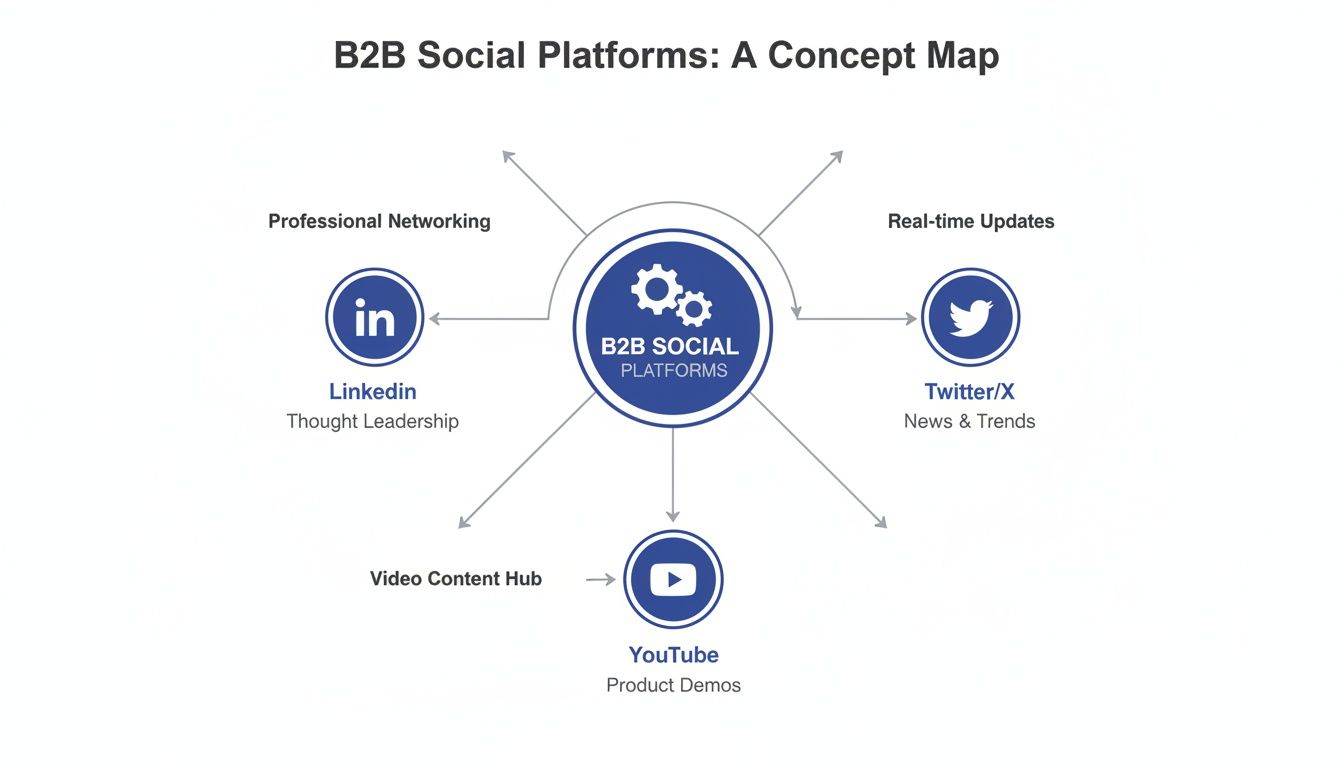
This map drives home the point: each channel has a distinct job to do. Your content strategy needs to reflect that.
Consistency Is Your Conversion Catalyst
Making amazing content is only half the job. To really win with social media and b2b, you have to be relentlessly consistent. Posting sporadically just won't cut it—you’ll never build momentum, and your content will get lost in today's crowded feeds.
Data shows that B2B brands posting 4-6 times per week on LinkedIn see the best results. This isn't just a vanity metric; it’s a strategic necessity. A staggering 97% of B2B marketers now consider LinkedIn essential for their content strategy, using it to build top-of-funnel awareness and guide prospects through the buying journey.
Keeping up that pace requires a system. To keep the content flowing without burning out, many teams use a Social Media Post Generator to spark ideas and bust through creative blocks. At the end of the day, it's that steady drumbeat of valuable content that builds the trust that ultimately leads to conversions.
Measuring Social Media Performance and ROI
So, how do you actually prove your B2B social media efforts are paying off? Likes and follower counts might give you a temporary ego boost, but they don’t exactly impress the C-suite or add a single dollar to the bottom line. The real magic happens when you connect your social activities directly to tangible business results.
This means you’ve got to stop obsessing over vanity metrics and start focusing on KPIs that actually move the needle. Instead of just counting retweets, you need to measure what matters: website clicks, lead form completions, and qualified lead conversions. This is how you stop treating social media like a branding afterthought and start using it as a predictable engine for revenue.
The first step is getting your tracking in order. Think of it like leaving a trail of breadcrumbs that leads a prospect from a single social post all the way to a closed deal. This trail is built with simple tools that help attribute every win back to its source.
From Clicks to Conversions
Connecting a tweet to a new customer requires tracking their journey. Don't worry, this isn't nearly as complicated as it sounds. The key is to add special tracking codes to every link you share on your social channels.
These codes are called UTM parameters, and they're just little snippets of text tacked onto the end of a URL. They act like a GPS, telling your analytics software exactly where a visitor came from. For example, a UTM can tell you a visitor landed on your site from a specific LinkedIn post you shared about a new case study.
By using them consistently, you can finally see which platforms, campaigns, and even individual posts are driving your most valuable traffic. You can stop guessing and start answering critical questions like:
- Which social channel is sending us the most demo requests?
- Did our last Twitter campaign actually generate any Marketing Qualified Leads (MQLs)?
- What was the conversion rate from our latest YouTube video series?
Identifying Your Most Important KPIs
Once your tracking is set up, you can zero in on the key performance indicators (KPIs) that truly matter for B2B. While the exact metrics will depend on your specific goals, they generally fall into a few key buckets.
Top-of-Funnel KPIs (Awareness & Engagement):
- Reach and Impressions: How many unique eyeballs are seeing your content?
- Website Clicks (Traffic): How many people are actually clicking through to your site from social?
- Share of Voice: How does your brand’s presence stack up against competitors in key industry conversations?
Mid-Funnel KPIs (Consideration & Lead Generation):
- Content Downloads: How many people are downloading your gated assets like whitepapers or ebooks?
- Lead Form Completions: How many prospects are filling out forms for webinars or newsletters?
- Cost Per Lead (CPL): How much are you spending on social media to acquire one new lead?
The goal is to move beyond what people think of your content and measure what they do because of it. Actionable metrics are the only true measure of B2B social media success.
For most B2B marketers, LinkedIn offers the most direct path to ROI. It's no surprise that 86% of B2B marketers see massive success on the platform, hitting up to 2x higher conversion rates compared to other channels. Even better, audiences exposed to brand messages on LinkedIn are 6x more likely to convert, drawing a straight line from social activity to measurable returns.
Unifying Your Analytics for Clearer Insights
Constantly jumping between different platform analytics tools is a recipe for headaches and missed opportunities. A centralized dashboard that pulls all your data into one place is non-negotiable for getting a holistic view of your performance.
Tools like PostSyncer provide unified analytics, letting you monitor everything in one spot, generate comprehensive reports, and prove your ROI to stakeholders without juggling a dozen browser tabs. This streamlined view makes it so much easier to spot trends, double down on what’s working, and fix what isn’t. Our detailed guide offers more on how to measure social media ROI.
Ultimately, your B2B social media efforts don't exist in a vacuum. Understanding the broader principles of measuring content marketing ROI is key to showing how your social activities fit into the entire marketing ecosystem and drive real business growth.
Building an Efficient B2B Social media Workflow
Let's be real. Trying to manage multiple social channels, content calendars, and team approvals without a solid system is a recipe for chaos. Juggling a mess of logins, spreadsheets, and endless email chains isn't just a headache—it actively sabotages the consistency your social media and B2B strategy needs to succeed.
An effective workflow isn't about grinding harder; it's about working smarter. It’s the engine that turns scattered, last-minute efforts into a predictable and scalable process. This means creating a central hub for planning, collaborating, scheduling, and automating so everyone, from the copywriter to the final approver, is on the same page.
Unifying Your Content Calendar
First thing's first: ditch the fragmented planning tools. A unified content calendar is your command center, the single source of truth for every post scheduled across every platform.
This bird's-eye view is a game-changer. It lets you spot content gaps before they become a problem, kill the last-minute scramble for posts, and ensure your messaging is balanced and strategic. Instead of your team asking, "What's going out on LinkedIn vs. Twitter/X today?" everyone can see the entire plan at a glance.
A unified calendar is more than a scheduling tool; it's a strategic map. It provides the clarity needed to coordinate campaigns, maintain brand consistency, and execute a cohesive B2B social media plan.
Think about it: in major markets, a staggering 90% of B2B marketers now push content through social media. This makes operational efficiency a massive competitive advantage. Getting your workflow right is essential for keeping up the posting frequency that platform algorithms reward. You can find more details on these B2B social media statistics on amraandelma.com.
Establishing Clear Approval Processes
One of the biggest bottlenecks I see in teams and agencies is a fuzzy content approval process. When nobody knows who has the final say, you get delays, miscommunication, and—worst of all—posts going live with glaring errors. A structured workflow puts an end to that friction.
An ideal system has a few key components:
- Defined Roles: Everyone knows exactly who is responsible for drafting, reviewing, and giving the final green light. No more guessing games.
- Collaborative Workspaces: Use a shared platform where team members can drop feedback directly on post drafts. Say goodbye to confusing email threads.
- Version Control: Easily track changes and revert to previous versions if needed. This simple feature eliminates so much confusion.
This kind of structure ensures your brand voice stays consistent and every piece of content is polished before it hits your audience. It's absolutely crucial for maintaining quality as you scale, especially when you have multiple stakeholders who need to weigh in.
Leveraging the Right Tools for Automation
Modern social media management platforms are the backbone of any efficient workflow. A great tool acts as your central hub, solving all those common pain points with smart, integrated features.
For example, a shared media library stops the endless hunt for approved logos, headshots, and video assets. Everyone on the team pulls from the same curated collection, locking in brand consistency. Some platforms even offer AI-powered scheduling, which takes the guesswork out of posting times by analyzing when your audience is most active to maximize the reach of every single post.
By bringing these functions under one roof, you empower your team to stop drowning in admin tasks and start focusing on what they do best: creating great content. This is how you build a workflow that doesn't just save time but actively drives better results.
Alright, let's stop talking theory and start building something real. Knowing what to do is one thing, but turning that knowledge into a concrete, day-to-day social media plan is where the magic really happens.
This is your roadmap. It's designed to take you from a high-level understanding of B2B social media to actually executing a strategy that gets results.
First things first: what does "winning" even look like for you? Vague goals like "more brand awareness" are useless because you can't measure them. Get specific. Is success generating 25 Marketing Qualified Leads (MQLs) from LinkedIn this quarter? Is it boosting website referral traffic from social by 15%? Now we're talking.
Once you know your destination, you need to know who you're talking to. And I mean really know them. Don't just settle for demographics. Build out detailed buyer personas. What are their job titles? What keeps them up at night? Where do they hang out online to find solutions? This single step will inform every single piece of content you create.
Building Your Strategic Foundation
With your goals and audience locked in, it's time to pick your battles. Spreading yourself across every platform is a recipe for burnout and mediocre results. Instead, find the one or two places where your ideal customers are already having conversations—which, for most B2B folks, is going to be LinkedIn. Go all-in there first. That means optimizing your profiles until they scream credibility, with consistent branding and a crystal-clear value proposition.
Now, you can start feeding the machine. Map out a 90-day content calendar that balances educational, relational, and promotional content. Planning ahead like this is the difference between being a strategic thought leader and a frantic content creator scrambling for something to post each morning.
Think of your action plan as a living GPS, not a stone tablet. It gives you a clear route, but it's flexible enough to let you detour when you see a better opportunity or hit unexpected traffic.
From Launch to Optimization
Finally, you have to prove it's all working. Set up a regular reporting schedule to track your progress and justify the investment. Use UTM parameters on every single link you share so you can trace every click, lead, and conversion back to its source. Then, set a recurring calendar invite—monthly or quarterly—to sit down and be honest about the data. What's connecting? What's falling flat? Where can you double down?
This structured approach makes sure your B2B social efforts are driven by purpose, not just gut feelings. It’s a simple, repeatable framework:
- Set SMART Objectives: Define specific, measurable, achievable, relevant, and time-bound goals.
- Analyze Your Audience: Create those deep-dive buyer personas to guide every decision.
- Pick & Polish Your Platforms: Choose your core channels and make your profiles look sharp and professional.
- Create a 90-Day Content Calendar: Plan your content mix to deliver consistent value.
- Establish a Reporting Cadence: Track your KPIs relentlessly to measure what matters and tweak your strategy.
Got Questions? We’ve Got Answers.
Jumping into social media for B2B can feel like you're trying to solve a puzzle. You’re not alone. Here are some of the most common questions we hear from marketers, with straightforward answers to help clear things up.
How Often Should My B2B Company Be Posting?
This is probably the number one question we get, and the answer is simpler than you think: consistency beats frequency, every single time.
Instead of burning out your team trying to post constantly, aim for a steady, reliable cadence. A great starting point for a professional hub like LinkedIn is 3-5 high-quality posts per week. For a more rapid-fire platform like X (formerly Twitter), you might find that 1-3 updates a day keeps you top-of-mind.
The real goal here isn’t to hit an arbitrary number. It’s to build a presence your audience can count on for valuable insights. A good scheduling tool is your best friend for this, letting you batch-create content and ensure your brand never goes silent.
What B2B Social Media Metrics Actually Matter?
It’s time to stop chasing vanity metrics. Likes are nice, but they don't pay the bills. The metrics that truly matter are the ones that show a direct line from your social media efforts to your business goals.
The most important B2B metrics are those that track a prospect's journey from a social post to a real business outcome. This is how you prove ROI and get more budget for what’s working.
Here are the heavy hitters you should be tracking:
- Website Referral Traffic: Who is clicking through from your social profiles to your website?
- Content Downloads: Are people actually downloading your gated content, like whitepapers or ebooks?
- Demo Requests & Lead Forms: Is social media directly feeding qualified leads into your sales pipeline?
When it comes down to it, the ultimate metric is the conversion rate of those social media leads into paying customers. That’s the number that really talks.
Can a B2B Brand Really Use Platforms Like Instagram or TikTok?
Yes, absolutely—as long as you go in with a smart, specific goal. These visual-first platforms aren't typically for direct lead gen, but they are incredibly powerful for humanizing your brand.
Think of them as your secret weapon for employer branding. You can showcase your company culture, spotlight your amazing team, and attract top talent in a way that a formal job post never could. They're also perfect for creating short, punchy educational videos that make complex topics easy to understand, reaching a much broader audience than you'd find on other channels.
Ready to build a social media workflow that's both efficient and scalable? PostSyncer gives you a single hub to plan, schedule, and analyze your content across every channel. It's time to prove your ROI and get your valuable time back. Start your free 7-day trial today and see the difference.