










Ready to turn your YouTube Shorts into a real income stream? The primary way to do that is through the YouTube Partner Program (YPP) and its ad revenue sharing model. It's a straightforward path, but there are specific milestones you need to hit first.
To get in the game, you'll need 1,000 subscribers and one of two key viewership metrics: either 10 million valid Shorts views in the last 90 days or 4,000 watch hours on your long-form videos.
This guide will break down exactly what you need to do to hit those numbers and start earning.
Your Roadmap to Shorts Monetization
Making money from short-form video has gone from a nice idea to a very real opportunity for creators. The explosion of YouTube Shorts created a direct monetization path, but you have to know the rules of the game to win. Unlike traditional videos where ads run before or during your content, Shorts monetization is a bit different—it’s all about shared revenue.
This model is built around two big milestones. First, you've got to build a community and hit that magic number of 1,000 subscribers. Once you're there, you need to prove your content can pull in serious eyeballs.
You have two ways to do this, and you only need to meet one:
- The Shorts-Focused Path: Rack up 10 million valid public Shorts views within a 90-day window.
- The Traditional Path: Accumulate 4,000 valid public watch hours on your long-form videos over the last 12 months.
The Shorts-focused path has quickly become the go-to for new channels. Why? Because a single viral Short can skyrocket you past that 10 million view mark almost overnight.
Getting a Handle on the Revenue Model
Once you’re in the YouTube Partner Program, it's really important to understand how the money is actually calculated. For 2025, YouTube takes all the revenue from ads that people see while scrolling the Shorts Feed and puts it into one big pot.
From that pot, a slice is taken out to cover music licensing costs. What's left is called the "Creator Pool," and this is what gets split among all monetizing creators. Your piece of the pie is based on your channel's share of total Shorts views in your country. Finally, you get to keep 45% of your allocated share.
The big takeaway here? Volume is king. While the revenue per thousand views (RPM) on Shorts is generally lower than for long-form videos, the sheer potential for massive viewership can lead to serious earnings. A single Short that hits millions of views can easily outperform a long-form video that took ten times the effort to create.
To give you a clearer picture, here's how the two eligibility paths compare side-by-side.
YouTube Partner Program Eligibility at a Glance
This table breaks down the two main ways you can qualify for the YPP and start monetizing your Shorts.
| Requirement | Shorts-Focused Path | Long-Form Focused Path |
|---|---|---|
| Subscribers | 1,000 subscribers | 1,000 subscribers |
| Viewership | 10 million valid public Shorts views | 4,000 valid public watch hours |
| Timeframe | Within the last 90 days | Within the last 12 months |
| Best For | Creators focused on high-volume, viral short-form content. | Creators with an established library of longer videos. |
Ultimately, this structure rewards consistency and the ability to go viral. The more you post, the more chances you have to hit it big.
If you're ready to dive deeper and turn those viral moments into a steady paycheck, check out this comprehensive guide on how to monetize YouTube Shorts. With a solid grasp of the rules, you can start building a content strategy that not only entertains but also pays the bills.
Qualifying for the YouTube Partner Program
Getting into the YouTube Partner Program (YPP) is the first major hurdle you need to clear to start earning ad revenue from your Shorts. Think of it as your official ticket to the monetization game. The numbers might look daunting at first, but when you break them down, they become a lot more achievable.
The big goal is to build a real audience. YouTube measures this with two key metrics: you need 1,000 subscribers and then proof that people are actually watching your stuff. You can prove that in one of two ways: either rack up 10 million valid public Shorts views in the last 90 days, or get 4,000 watch hours on your long-form videos in the past year.
For anyone all-in on vertical video, that 10-million-view target is your direct path forward.
Getting Your First 1,000 Subscribers with Shorts
Shorts are an absolute powerhouse for discovery. Unlike long-form content that often depends on search traffic or your existing subscriber base, the Shorts feed is built to push fresh content to a massive, new audience. This makes it perfect for explosive channel growth.
Your job is to create a Short so good that a random viewer feels compelled to hit that subscribe button.
- Solve a Problem, Fast: Think quick tips, life hacks, or simple solutions. A 30-second Short showing the right way to chop an onion will earn more subscribers than another generic dance video. It provides instant value.
- Nail Down Your Identity: Stick to a theme. If you’re a gaming channel, focus on epic clips, funny moments, or quick tutorials for one specific game. This tells viewers exactly what they'll get if they subscribe.
- Ask for the Sub: Don't be shy about a call-to-action (CTA). A simple text overlay or a quick voiceover at the end saying, "Follow for more daily tips!" can make a huge difference. You have to ask for what you want.
The real mindset shift is seeing every single Short as an audition. You're not just posting a video; you're giving someone a reason to join your community. Deliver value or entertainment immediately, and you've got them hooked.
This diagram breaks down the main monetization journey for Shorts creators.
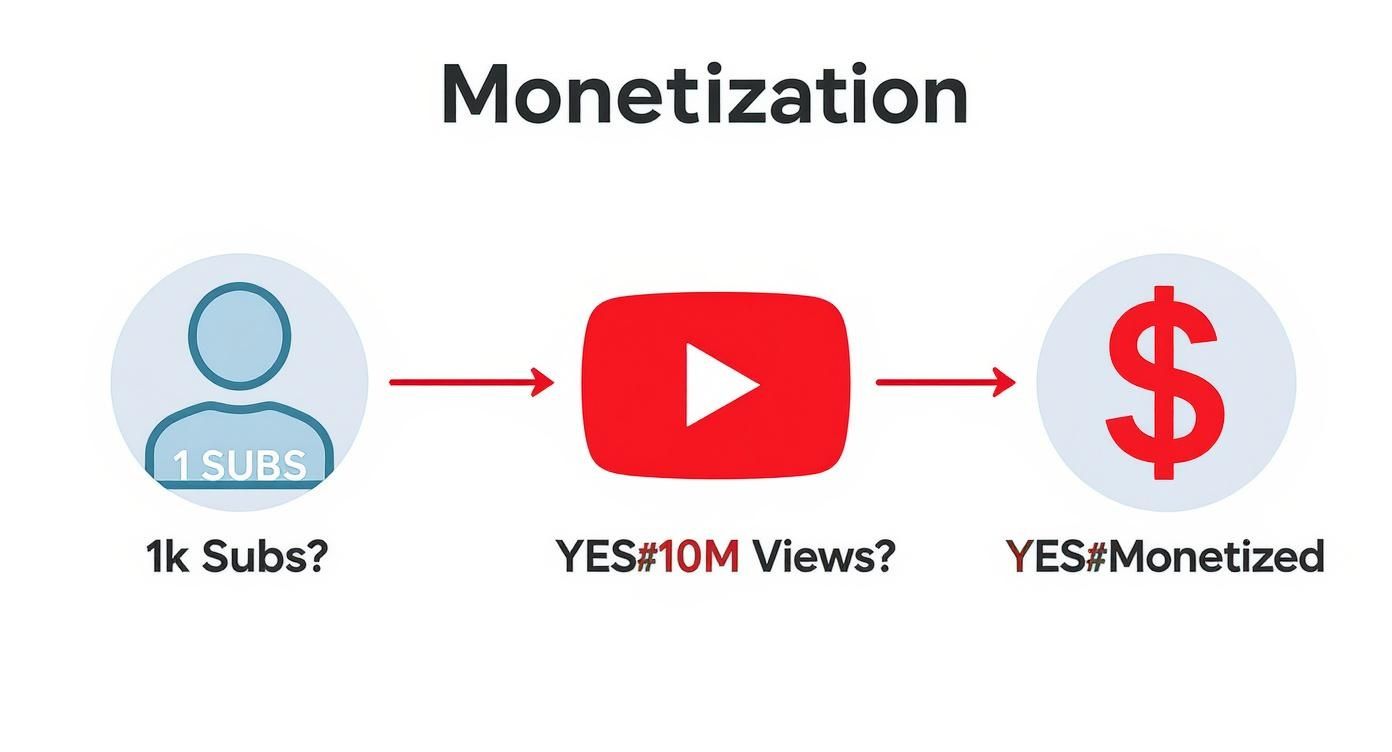
As you can see, it all starts with building that core community and then proving your content can pull in a huge audience.
The Game Plan for 10 Million Views
Hitting 10 million views in 90 days isn't about one viral miracle. It's about a consistent strategy built on volume, trends, and smart optimization.
First, you need to become a student of the Shorts feed. Spend 15-20 minutes every day just scrolling to see what audio and formats are blowing up in your niche. Using a trending sound can get your video swept up in a wave of millions of viewers watching other Shorts with that same audio.
Next, get serious about your hashtags. You need a mix of broad and specific tags to help the algorithm figure out who to show your content to.
- Broad:
#Shorts,#YouTubeShorts - Niche-Specific:
#WoodworkingTips,#ApexLegendsClips,#MealPrepIdeas - Trend-Specific:
#SpecificChallengeName
This blend tells YouTube what your video is about and who might want to see it. You can track all of your progress right inside your YouTube Studio dashboard.
The 'Earn' tab removes all the guesswork, showing you exactly where you stand on your journey to hitting the YPP requirements.
Finally, and this is non-negotiable, you have to play by the rules. Make sure your content strictly follows YouTube's Community Guidelines and monetization policies. That means no re-uploading unedited movie clips, no using copyrighted music that isn't from the Shorts library, and absolutely no spammy tactics.
Building your channel the right way from day one ensures that when you do hit those big numbers, you'll actually be eligible to monetize and keep earning for the long haul.
Creating Shorts People Actually Watch and Share
Let's be real: hitting the eligibility numbers is one thing, but actually making money on Shorts requires something more. You need to build a loyal audience that smashes the share button and keeps coming back. Just throwing a video up and hoping for the best isn't a strategy.
To really get traction, you have to nail the creative formula that makes a Short irresistible.
It all boils down to the hook. You have less than three seconds—seriously, that's it—to stop someone from swiping away. In the blink-and-you'll-miss-it world of the Shorts feed, that first impression is everything.

Mastering the Art of the Hook
A killer hook doesn't waste time. It instantly sparks curiosity or promises value, letting the viewer know their next 30 seconds are in good hands.
Forget the slow, cinematic intros. Jump straight into the action. If you're doing a tutorial, show the amazing final product first. If it's a story, start at the most dramatic moment.
Here are a few hook strategies I've seen work wonders:
- Ask a provocative question: "Did you know you've been using this kitchen tool wrong your whole life?"
- Make a bold statement: "This is the only productivity hack you'll ever need."
- Show a surprising visual: Kick things off with a wild image or a super satisfying before-and-after shot.
This initial grab is what separates a video that fizzles out with a few hundred views from one that the algorithm picks up and sends into the stratosphere.
Driving Retention and Replays
Okay, you've got their attention. Now your job is to keep them glued to the screen until the very end—and maybe even get them to watch it again. High audience retention is a massive signal to YouTube that your content is top-notch.
One of the slickest tricks in the book is the "perfect loop." This is where the end of your video flows seamlessly back into the beginning, making viewers re-watch without even realizing it. It's a simple way to rack up watch time.
On-screen text is another secret weapon. A lot of people watch with the sound off, so use captions to highlight key information or add extra context. Quick, punchy text that pops on and off the screen keeps eyes moving and guides the story.
If you're looking for more ways to level up your short-form content, check out these Shorts creation tips from ShortGenius.
The Power of Niches and Trending Audio
Finding your niche and sticking to it is how you turn casual scrollers into die-hard subscribers. If someone stumbles upon your Short about restoring vintage cameras and loves it, they’re way more likely to subscribe if they know you'll be delivering more of that same awesome content.
A laser-focused niche helps you:
- Build a community: You’re not just getting views; you're attracting people with a shared passion.
- Become an authority: You become the go-to expert for that specific topic.
- Attract brands: Companies will see your channel as the perfect place to reach their target audience for sponsorships.
On top of that, hopping on trending audio is one of the fastest ways to get discovered. The algorithm loves to push videos using popular sounds. The trick is to not just copy the trend but to adapt it creatively to your own niche.
The growth of Shorts has been absolutely staggering. Since its launch, the platform has exploded to over 70 billion daily views. Shorts are also fantastic for converting viewers into subscribers, making them a powerful tool for overall channel growth.
Putting these creative strategies together is the key to making content that doesn't just get views but builds a real foundation for your channel. Effective video marketing for social media is all about building a system that works for you, again and again.
Alright, you've officially made it into the YouTube Partner Program. Congratulations! That’s a huge milestone. Now, let’s get you paid. The next step is flipping the monetization switch for your Shorts, and it’s a critical one that a surprising number of creators miss right out of the gate.
The first thing you need to do is explicitly agree to the Shorts Monetization Module inside your YouTube Studio. This is a totally separate agreement from the main YPP terms you already accepted. If you skip this, your Shorts will get zero ad revenue, no matter how many millions of views they rack up. Think of it as officially raising your hand and telling YouTube, "Yes, please deal my content into the Shorts Feed ad-revenue pool."
How Shorts Earnings Actually Work
Getting paid for Shorts is a completely different beast than long-form video, so it's important to set your expectations correctly. Unlike traditional videos, ads don't play on your Short. Instead, they appear between Shorts as people are swiping through the feed.
YouTube takes all the money generated from these ads and puts it into one big "Creator Pool."
From there, the first cut goes to pay for music licensing. What's left is then divided up among all monetizing creators based on their share of the total Shorts views in each country. You, as the creator, get 45% of whatever your allocated share is.
This model is exactly why your Shorts income can feel a bit unpredictable at first. Your earnings are constantly being influenced by a few key factors:
- Total Shorts Views: Pretty straightforward—the more valid views you get, the bigger your slice of the pie.
- Viewer Location: This is a big one. Ad rates are wildly different from country to country. Views from a place like the US or the UK are simply more valuable than views from regions with lower ad spend.
- Music Usage: If you use popular, commercially licensed tracks in your Shorts, a portion of that revenue goes to the music publishers before any of it is allocated to you.
Finding Your Revenue Data in YouTube Analytics
Your YouTube Studio is your command center. This is where you’ll see what’s working, what’s not, and how to sharpen your strategy for monetizing your YouTube Shorts.
To see the numbers, just head to YouTube Studio > Analytics > Revenue. From there, you can filter by content type to see only your Shorts performance. You’ll want to pay close attention to the relationship between your views and your estimated revenue.
You're going to notice that your RPM (Revenue Per Mille, or what you earn per 1,000 views) for Shorts is way, way lower than for your long-form videos. Don't panic. This is completely normal.
The name of the game with Shorts is scale. A long-form video might earn a healthy few dollars per thousand views, but a successful Short can pull in hundreds of thousands, or even millions, of views, earning its keep through sheer volume.
Using Your Data to Actually Make More Money
Your analytics tell a story if you know how to read them. Start looking for patterns in your best-performing Shorts. Is there a certain sound they all use? A specific length that seems to hit a sweet spot? A particular style of hook? Finding these common threads is how you develop a repeatable formula for success.
For example, maybe you dig in and realize your Shorts that are 15-20 seconds long have the best audience retention and bring in the most revenue. That's not a coincidence; it's a direct signal from your audience to make more content just like that.
Get comfortable using the "Advanced Mode" in your analytics to get even more granular. You can compare different Shorts side-by-side to figure out why one went viral and another one flopped. Was it the traffic source? The time of day? The audience demographics? Answering these questions with data—not just guesswork—is how you transform your channel from a hobby into a reliable income stream. Your analytics dashboard isn't just a report card; it's a roadmap.
Building Income Streams Beyond Ad Revenue
Relying only on the Shorts ad revenue share is a rookie mistake. It's like building your entire business on rented land. To create a truly resilient and profitable brand, you have to think bigger. Ad revenue is a fantastic starting point, but the real, sustainable cash flow comes from building a diverse ecosystem around your content.
Think of your Shorts as the ultimate top-of-funnel tool. They’re phenomenal at grabbing millions of eyeballs, building a community at warp speed, and introducing new people to your brand every single day. The trick is to then guide that fired-up audience toward other income streams that you actually own and control. This is the leap from just getting views to building real wealth.

Landing Brand Deals and Sponsorships
For many creators, brand deals are where the serious money is made. It makes sense—brands are desperate to connect with the massive, engaged audiences on short-form video and will pay top dollar to reach a loyal community like yours.
And no, you don't need a million subscribers to get started. Brands are increasingly looking for micro-influencers who have sky-high engagement in a specific niche.
Here’s how to get on their radar:
- Build a Media Kit: This is your professional resume for brands. It needs to showcase your channel analytics (subs, average views, audience demographics), link to your best-performing Shorts, and provide clear contact info.
- Pitch with Purpose: Don't just blast out generic emails. Research brands that genuinely fit your content and your audience. Your pitch needs to clearly explain why a partnership with you is a no-brainer for them.
A sharp, personalized pitch instantly shows you've done your homework and aren't just looking for a quick paycheck. That’s how you build long-term relationships with brands that will hire you again and again.
Integrating Affiliate Marketing Naturally
Affiliate marketing is a brilliant, low-lift way to generate passive income. The whole game is simple: you recommend a product or service you actually like, and you get a cut of every sale that comes through your unique affiliate link.
But the secret ingredient here is authenticity. Your audience follows you because they trust your taste. If you start shilling junk, you’ll lose that trust in a heartbeat. Only recommend products you genuinely use and believe in.
Pro Tip: Simply dropping a link in your description is lazy and ineffective. Instead, create a Short that shows the product solving a real problem. A quick 30-second demo of a tool in action is infinitely more persuasive than a text link.
For example, a cooking channel could make a Short titled “The one kitchen gadget I can’t live without,” actually use it to make something amazing, and then pop the Amazon affiliate link in a pinned comment. This strategy works wonders across platforms, which we dig into in our guide on how to monetize Instagram Reels.
Launching Your Own Products and Merch
This is the holy grail of creator monetization: selling something that is 100% yours. We’re talking about everything from merch like t-shirts and hoodies to digital products like e-books, video presets, or online courses. With this model, you have total control over the product, the marketing, and most importantly, the profits.
Your Shorts become your free, built-in marketing engine. A fitness creator can use Shorts to drive traffic to a sales page for their custom workout program. A travel vlogger can sell the very photo filters they use to give their videos that signature, cinematic look.
To put it all into perspective, let's compare these methods head-to-head.
Shorts Monetization Methods Comparison
The table below breaks down the most common monetization avenues for Shorts creators, helping you see where each one shines.
| Monetization Method | Earning Potential | Effort Level | Best For |
|---|---|---|---|
| Shorts Ad Revenue | Low per view, high at scale | Low | All eligible creators, as a foundational income layer. |
| Brand Sponsorships | High | Medium | Creators with an engaged, niche audience. |
| Affiliate Marketing | Medium | Low-Medium | Creators who can authentically recommend products. |
| Selling Own Products | Very High | High | Established creators with a loyal community. |
While the RPM for Shorts ads might look small, the real power comes from combining these streams. A creator with one million subscribers could realistically earn anywhere from $2,000 to $40,000 per month by blending ad revenue with sponsorships and product sales. Remember, getting one million views on Shorts might only net $10 to $300 in ad revenue, but using those same views to sell even a handful of high-ticket digital products could be a game-changer.
By branching out, you stop being just a YouTuber and start becoming a true entrepreneur. You’re building a brand that can stand on its own, free from the whims of any single platform’s algorithm or policy changes.
Streamlining Your Content Creation Workflow
Having a single viral moment is great, but consistency is what builds a real, income-generating channel. To truly nail how to monetize YouTube Shorts, you need a system—a workflow that keeps you from burning out while the content keeps flowing. This is the final, and most critical, piece of the puzzle.
It all starts with a plan. A simple content calendar is your best friend here, whether it’s a basic spreadsheet or a dedicated app. I always recommend mapping out your video ideas for the next week or even the whole month. Group them into content pillars that fit your niche. This one small step sets you up for batch production, which is a total game-changer.
Instead of trying to film a new Short every single day (a recipe for exhaustion), block out a few hours to film five or ten at once. You save a ridiculous amount of time on setting up lights, mics, and your camera. Once they're filmed, you can edit and schedule them out, guaranteeing you have a steady stream of content ready to roll.
Essential Tools for Efficient Creation
The right tools can seriously speed up your process without making your content look cheap. We're lucky to have so many powerful mobile editing apps designed specifically for vertical video. They make it incredibly easy to drop in trending audio, add slick text animations, and make those quick cuts that keep viewers hooked—all from your phone.
But beyond editing, scheduling platforms are where the real magic happens for consistency. You can upload all your finished Shorts, then set them to go live at the perfect time, even if you’re asleep or on vacation. This keeps your channel active, which is a massive signal to the YouTube algorithm that you're a serious creator.
If you want to get really granular with your scheduling, our guide on how to automate social media posting is packed with advanced strategies.
The goal isn't just to work harder; it's to work smarter. A streamlined system frees up your mental energy to focus on what truly matters: creative ideas that connect with your audience and drive growth.
This is exactly what a centralized hub for managing content looks like. It’s all about seeing your entire schedule at a glance.
Platforms like PostSyncer let you visualize your whole content pipeline, from draft to publication. It makes it so much easier to spot gaps in your calendar and maintain that crucial, consistent presence across all your channels.
The Power of Smart Repurposing
Never, ever let a good piece of content die after one post. Smart repurposing is your secret weapon for squeezing every last drop of value out of the work you’ve already done.
- Long-Form to Shorts: Got a 10-minute video? I guarantee you can chop it into at least a dozen high-impact Shorts. Hunt for the best takeaways, the funniest moments, or the most compelling little stories within your longer videos.
- Cross-Platform Amplification: Your top-performing Shorts shouldn't just live on YouTube. Push them out to TikTok and Instagram Reels. You can tap into entirely new audiences and funnel that traffic right back to your YouTube channel.
By building a workflow that’s structured, supported by the right tools, and focused on repurposing, you create a sustainable engine for growth. This is the system that ensures you can consistently publish enough content to stay relevant and, ultimately, monetize your channel for the long haul.
Answering Your Top Shorts Monetization Questions
When you’re trying to turn your Shorts into a real revenue stream, a few key questions always pop up. It's easy to get tangled in the details of monetization rules, so let’s clear the air on some of the most common points of confusion.
Do I Need 10M Views AND 4K Watch Hours?
Nope, definitely not. This is probably the biggest myth I see floating around. You only need to hit one of those major milestones to qualify for the YouTube Partner Program (YPP), not both.
Let’s break it down. To apply, you need 1,000 subscribers plus one of the following:
- 10 million valid public Shorts views within the last 90 days.
- 4,000 valid public watch hours on your regular, long-form videos in the last 12 months.
The best part? Once you’re in the YPP, it doesn't matter which path you took. You can start earning from everything—Shorts Feed ads, ads on your long-form videos, Super Thanks, the works.
Can I Make Money If I Use Copyrighted Music?
This is a tricky one, but the answer is usually no—unless you play by YouTube’s rules.
Your safest and smartest option is to use music directly from the official Shorts audio library. When you pick a track from there, YouTube handles everything behind the scenes, splitting the revenue between you and the music rights holders. Your video stays monetized, and you stay out of trouble.
But if you grab a trending song from outside that library, you're taking a big risk. Almost without fail, any ad revenue generated by that Short will go directly to the copyright owner, not you.
A good rule of thumb: If you want to guarantee you get paid for your views, stick to the audio YouTube gives you right inside the Shorts editor. It’s been pre-cleared for exactly this purpose.
Why Is My Shorts RPM So Low Compared to Long-Form?
If you've looked at your analytics, you’ve probably noticed that your Shorts RPM (Revenue Per Mille, or earnings per 1,000 views) is way lower than your long-form videos. Don't panic; this is completely normal.
It all comes down to how the ads work. On a regular video, ads are served directly on your content—pre-roll, mid-roll, you name it. You get a direct cut.
The Shorts Feed is different. Ads play between Shorts, not on them. All the money from those ads gets thrown into one big pot. At the end of the month, YouTube divides that pot among all monetized creators based on their share of the total views. Because you're sharing the pie with everyone else, your individual slice per 1,000 views is naturally smaller.
The entire strategy for Shorts monetization is built on volume. You make up for the lower RPM by getting a massive number of views, something Shorts are specifically designed to do.
Ready to get a handle on your content schedule and make your monetization goals a reality? PostSyncer gives you one clean platform to plan, schedule, and analyze all your Shorts and other social media content. Consistency is everything, and we can help you achieve it. Streamline your entire workflow by visiting https://postsyncer.com and start your free trial today.