










Let's be real—a social media strategy is more than just posting whenever you feel like it. It's a deliberate plan to hit specific business goals. The whole point is to ditch the random acts of content and build a measurable framework that guides every single thing you do online.
Building Your Foundation for Social Media Success

Before you even think about creating a single post, you need to lay the groundwork. This is the part that saves you from wasting time and money down the line, ensuring every piece of content has a clear "why" behind it. It all boils down to one question: What are we actually trying to achieve here?
So many brands get caught up chasing vanity metrics—things like follower counts or a flood of likes. They feel good, sure, but they don't pay the bills. Your strategy needs to be anchored to clear, measurable objectives that actually move the needle for the business. This is where a framework like SMART goals becomes your best friend.
Define Your SMART Social Media Goals
Using the SMART framework is how you turn a fuzzy wish into a concrete target. It forces you to make your goals Specific, Measurable, Attainable, Relevant, and Time-bound.
Let's break it down. A vague goal like "increase brand awareness" is useless. A SMART goal, on the other hand, gives you a clear roadmap: "Increase our Instagram reach by 25% and mentions by 15% over the next quarter by launching a user-generated content campaign." See the difference? Now you have a target, a deadline, and a tactic.
Here's how to sharpen up other common goals:
- Vague: "Get more website traffic."
- SMART: "Drive 500 new website visitors per month from LinkedIn by sharing two blog posts and one case study video each week for Q3."
- Vague: "Improve customer service."
- SMART: "Decrease average social media response time to under two hours within the next 60 days by implementing a dedicated monitoring workflow."
Setting clear objectives from the start is non-negotiable. Without a defined destination, you can't measure progress, prove ROI, or make smart decisions to optimize your approach.
To make this even clearer, you need to connect your broader business objectives directly to the social media metrics you'll be tracking. Here’s a simple table to help you map that out.
Connecting Business Goals to Social Media KPIs
This table breaks down how big-picture business goals translate into specific, trackable social media objectives and their corresponding KPIs. It’s all about measuring what truly matters.
| Business Goal | Example Social Media Objective | Primary KPI to Track | Secondary Metric |
|---|---|---|---|
| Increase Brand Awareness | Expand reach to a new audience segment. | Impressions & Reach | Follower Growth, Mentions |
| Generate More Leads | Capture contact info from interested users. | Leads Generated (from forms) | Link Clicks, Conversion Rate |
| Drive Website Traffic | Send users to a specific landing page or blog. | Website Clicks | Click-Through Rate (CTR) |
| Improve Brand Loyalty | Build an engaged community of followers. | Engagement Rate (Likes, Comments, Shares) | Positive Sentiment, Response Time |
| Increase Sales | Drive direct purchases from social channels. | Revenue from Social | Conversion Rate, Cost Per Acquisition |
Thinking this way ensures your social media efforts are always serving a larger purpose, not just existing in a silo.
Conduct a Competitive Analysis
With your goals set, it's time to peek at what your competitors are doing. The goal here isn't to copy them—it's to find gaps and opportunities. A solid competitive analysis shows you what's working (and what's flopping) in your industry so you can carve out your own unique space.
Start by picking 3-5 of your top competitors. Then, dive into their social media presence and ask some hard questions:
- Where are they most active? Which platforms are they pouring resources into?
- What's their content mix? Are they heavy on video, articles, memes, or something else?
- What does their brand voice sound like? Is it corporate and stuffy or fun and casual?
- How’s their engagement? Which of their posts are actually getting people to react?
- What are they not doing? Are there any audience needs or content formats they’re completely ignoring?
Maybe you find a top rival crushing it on LinkedIn with professional content but their Instagram is a ghost town. That’s your opening. You can own the visual conversation on that platform. Document everything you find—it will be gold for positioning your own brand.
Perform a Social Media Audit
The last piece of the foundation is looking in the mirror. A social media audit is a no-nonsense review of your existing profiles to see where you stand right now. This gives you a baseline for performance, helps you spot inconsistencies, and lets you clean house before launching your new strategy.
For each of your social profiles, grab this info:
- Profile Consistency: Are your logo, bio, and username the same everywhere? If not, fix it.
- Performance Review: What’s your current follower count, average engagement rate, and which posts have done the best in the last 90 days?
- Audience Demographics: Who’s following you right now? Does it match the audience you want to reach?
- Platform Purpose: Is it obvious why you're on this channel? Does your content fit what people on that platform expect to see?
This audit might show that your Facebook page has terrible engagement but sends a ton of traffic to your site, while your Twitter gets lots of mentions but zero clicks. These are the kinds of insights you need to decide where to focus your energy and budget. This groundwork means you’re not just guessing—you’re starting day one with data-backed decisions.
Finding and Understanding Your Ideal Audience
Alright, you've got your goals locked in. Now comes the part that separates the pros from the amateurs: figuring out exactly who you’re talking to.
Posting content into the void and hoping the right people find it is a recipe for burnout. To get real results, you have to get laser-focused on the specific group of people most likely to become your loyal customers and biggest fans.
Globally, there are an estimated 5.42 billion social media users, and the average person is active on 6.83 different platforms each month. The noise is deafening. To cut through it, you need to know your audience inside and out.
A truly effective strategy is built on a deep understanding of your audience's behaviors, motivations, and pain points. You need to know what keeps them up at night, what makes them laugh, and where they hang out online.
Moving Beyond Demographics to Psychographics
Knowing your ideal customer is a 25-year-old urban professional is a decent start, but it’s nowhere near enough. To create content that actually stops the scroll, you have to dig into their psychographics—the psychological drivers behind their actions.
This is where you answer the questions that really shape your content:
- What are their biggest struggles related to what you do? This is your secret weapon for creating problem-solving content.
- What do they value? What do they aspire to be? Aligning with these builds a genuine connection.
- What kind of humor or tone do they respond to? This is what defines your brand's voice and personality.
- Who do they already follow for advice and inspiration? This shows you potential collaborators and content styles that work.
Think of it this way: demographics tell you who your audience is, but psychographics tell you why they buy. That "why" is the key to creating content they can't ignore.
Your goal is to know your audience so well that your content feels like it was made just for them. This is how you turn passive scrollers into an engaged community that trusts your brand.
For a deeper dive into this critical step, check out our complete guide on how to identify your target audience. It’ll help you lay a rock-solid foundation for everything else.
Building Detailed Audience Personas
An audience persona is basically a character profile of your ideal customer. Giving this fictional person a name, a face, and a backstory makes it infinitely easier to create content that speaks directly to them.
Instead of asking, "What should our company post today?" you'll start asking, "What would 'Marketing Manager Maya' find genuinely useful or entertaining?"
Your persona should be a mix of demographic and psychographic details.
Example Persona: "Marketing Manager Maya"
| Category | Details |
|---|---|
| Demographics | 32 years old, lives in a major city, works at a mid-sized tech company, has a master's degree. |
| Goals | Wants to prove the ROI of her marketing efforts to get a promotion. Needs to stay on top of industry trends to look smart. |
| Pain Points | Feels overwhelmed by the sheer number of marketing tools. Struggles to find time for big-picture creative strategy. |
| Online Habits | Spends time on LinkedIn for professional content, follows industry leaders on X, and uses Instagram for lifestyle inspiration. |
| Content Preferences | Prefers quick-read articles, data-driven case studies, and short, educational videos she can watch on her commute. |
Creating 2-3 of these detailed personas gives your team a crystal-clear, unified vision of who you're trying to reach. This consistency is everything.
The Power of Social Listening
One of the best (and most overlooked) ways to understand your audience is to just listen to the conversations they’re already having. Social listening is the art of monitoring social media for mentions of your brand, your competitors, and keywords relevant to your industry.
It’s like having a focus group running 24/7, giving you unfiltered insights into what people really think and feel.
Here’s how you can put it into practice:
- Track Industry Keywords: Monitor terms related to your field to discover common questions and frustrations. If you sell a project management tool, you might track "team collaboration struggles" or "best productivity hacks."
- Monitor Your Competitors: See what customers are saying about your rivals. Are they raving about a specific feature? Complaining about terrible customer service? These are golden opportunities handed to you on a silver platter.
- Analyze Unbranded Conversations: Find out where your audience talks about their needs without mentioning any specific brands. This could be in niche Facebook groups, Reddit communities, or under specific hashtags.
When you actively listen, you stop making assumptions and start gathering real-world intelligence. This insight allows you to join relevant conversations, discover unmet needs, and find content gaps that your brand is perfectly positioned to fill.
Alright, you've nailed down your goals and have a crystal-clear picture of who you're talking to. Now comes the fun part: building the creative engine that will power your entire social media strategy.
This breaks down into two make-or-break decisions: figuring out what you’re going to talk about (your content pillars) and deciding where you’re going to say it (your platforms). Get these two things right, and you're well on your way to building a brand people actually want to follow.
Choosing Your Platforms and Content Pillars
A classic rookie mistake is trying to be everywhere at once. It's a surefire way to stretch your team thin, dilute your message, and burn out fast. The real secret is to be ruthlessly selective. You need to show up where your ideal audience—those personas you just spent time building—already hangs out.
Let’s make this real. A B2B software company chasing CTOs will get way more traction creating in-depth video case studies for YouTube and sharp thought leadership articles for LinkedIn. On the flip side, a DTC fashion brand targeting Gen Z should be all-in on trendy, short-form videos for TikTok and stunning visual carousels for Instagram. See the difference? Go where your people are.
Developing Your Core Content Pillars
Think of your content pillars as the 3-5 core themes your brand will own. These are the big-picture topics you’ll return to again and again. They act as a strategic filter, making sure every single thing you post is relevant to your brand and genuinely interesting to your audience. This simple framework is what stops you from posting random, off-the-cuff content just to fill the void.
So, how do you find them? You're looking for that sweet spot where what you know and what your audience cares about overlap.
- Your Expertise: What are you a genuine authority on? What unique perspective can you bring to the table that no one else can?
- Your Audience's Passions: What keeps them up at night? What are their biggest pain points, goals, and interests? What kind of content are they already smashing the 'like' button on?
Let's run a quick scenario: A B2B Tech Company
Imagine a company that sells project management software. Their pillars might look something like this:
- Productivity Hacks: Actionable tips and tricks for getting more done.
- Team Collaboration: Smart advice for improving communication and workflow.
- Leadership Insights: Real talk for managers on building and leading effective teams.
- Customer Stories: Showing, not just telling, how real clients use their software to win.
These pillars are broad enough to fuel endless content ideas but specific enough to carve out a clear identity. Every post, from a quick tip on LinkedIn to a deep-dive case study, now has a home.
Content pillars are your brand's thematic guardrails. They ensure consistency, build topical authority, and make content creation infinitely easier because you're no longer starting from a blank slate every morning.
Matching Content Formats to Platforms
You've got your pillars and you know which platforms you're targeting. The final piece of the puzzle is matching the right content format to the right channel. What absolutely crushes it on one platform can be a total flop on another.
For instance, LinkedIn's algorithm is currently loving text-heavy posts with a simple image or, even better, a document carousel. Instagram, meanwhile, is all about visual media—Reels, Stories, and high-quality photo carousels are king.
Here’s a quick rundown of popular formats and where they really shine:
- Short-Form Video (Reels, Shorts, TikToks): Perfect for grabbing attention with quick tips, behind-the-scenes glimpses, and entertaining clips. This format is a beast for reaching new audiences because it's so incredibly shareable.
- Image Carousels: A fantastic way to break down complex ideas into easy-to-digest slides. They work wonders for educational content and mini-guides on Instagram and LinkedIn.
- Long-Form Video (YouTube): This is your home for deep-dive tutorials, webinars, customer testimonials, and interviews where you can really flex your expertise and build serious authority.
- Live Streams: An amazing tool for real-time engagement. Think Q&As, product launches, and building a genuine connection with your community on platforms like Facebook, LinkedIn, and YouTube.
- Text and Link Posts: Don't sleep on the classics! These are still highly effective on platforms like X (formerly Twitter) and LinkedIn for sharing news, asking thought-provoking questions, and driving traffic back to your website.
If you really want to make an impact, mastering the top-performing formats is non-negotiable. To go deeper, check out this a strategic guide to social media video.
By strategically aligning your pillars, platforms, and formats, you create a cohesive and powerful content machine that consistently delivers value and gets you the results you're looking for.
Creating Your Content Calendar and Workflow
An incredible social media strategy is just a document until you build a system to actually do the work. This is where your big ideas, audience research, and content pillars get real. A solid content calendar and a clear workflow are what separate the brands that post sporadically from the ones that build a consistent, powerful presence.
Honestly, this step is all about moving from "What should we post today?" panic to a calm, forward-thinking plan. When you know what’s on the schedule for next week and next month, you free up so much mental energy. You can finally stop feeding the algorithm and start creating truly high-quality, impactful content.
Structuring Your Social Media Content Calendar
Think of your content calendar as your command center for all things social. It can be a sophisticated project management tool or a simple spreadsheet—the format doesn't matter as much as the function. Its job is to plan, organize, and track every piece of content from a rough idea to a published post.
If you're starting from scratch, we have an in-depth guide on creating a content calendar for social media that walks you through the nitty-gritty.
A good way to start is by mapping out broad monthly themes that tie back to your content pillars or key business events. For a fitness brand, January might be all about "New Year's Resolutions," February could focus on "Heart Health," and March could be dedicated to "Spring Training Prep."
From there, you can drill down to the weekly details:
- Pillar Alignment: Make sure each post is assigned to one of your core content pillars. This is how you guarantee a balanced feed.
- Format Specifics: Is it a Reel? A carousel? A single image? Note it clearly so everyone knows what to create.
- Key Components: You'll want columns for the post copy, links to visual assets, a list of hashtags, and any accounts you plan to tag.
- Status Tracking: Simple labels like "Idea," "In Progress," "Needs Approval," and "Scheduled" are a lifesaver for keeping the team aligned.
This simple diagram shows how raw ideas become published content—a process your calendar is built to manage.
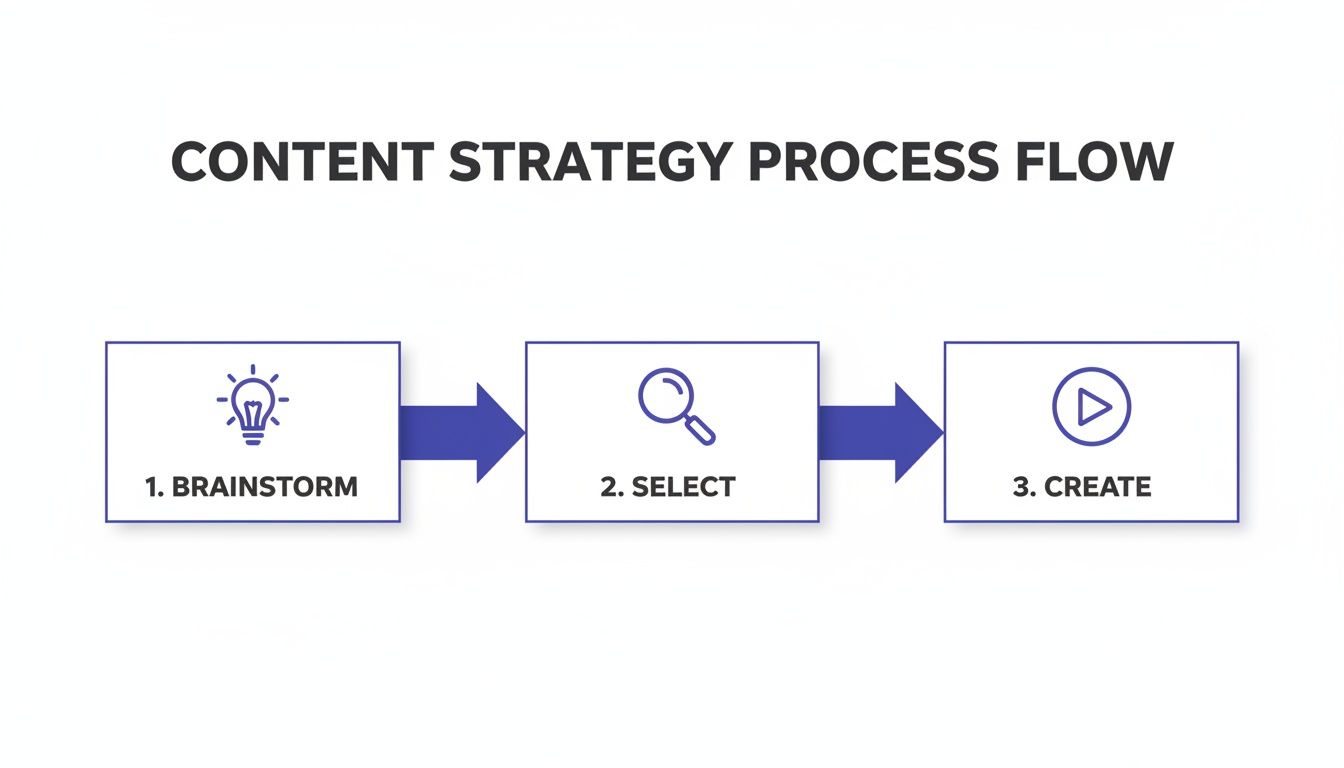
It’s all about moving from brainstorming to selecting the strongest concepts and, finally, to the creation phase.
Nailing Your Posting Cadence and Content Mix
Here’s a hard truth I’ve learned: consistency is far more important than frequency. Posting three genuinely great pieces a week will always beat posting seven mediocre ones. The perfect cadence really depends on the platform and your audience, but a solid starting point for networks like Instagram and LinkedIn is 3-5 times per week.
A huge part of your cadence is your content mix, and these days, that means video. It's not just a "nice to have" anymore; it's essential for growth. With 78% of people saying they prefer to learn about products through short videos, you simply can't afford to ignore it. The data on video in social media marketing from ClearVoice.com is pretty compelling if you need more convincing.
A successful workflow is built on clarity. Everyone involved should know exactly what they are responsible for, what the deadlines are, and who has the final say. This prevents bottlenecks and ensures a smooth journey from concept to scheduled post.
One of the best ways to keep your workflow efficient is to embrace content batching. This just means dedicating a block of time to a single type of task. For instance, spend one afternoon scripting all your videos for the month. Use another day for shooting, and a third for editing and scheduling. Batching is a game-changer for productivity because it cuts down on the mental drain of switching between different types of tasks.
Defining Roles and Approval Workflows
Whether you're a one-person show or part of a larger team, a documented workflow is non-negotiable. It's what keeps your quality high and your brand voice consistent. A clear process catches mistakes before they go live and makes sure every post aligns with your strategy.
A typical content workflow might look something like this:
- Ideation: The social media manager brainstorms ideas based on the calendar's themes.
- Creation: The content creator gets to work writing copy and designing visuals or editing video.
- Review: The draft is passed to a manager or client for feedback. This is where things often get stuck, so setting firm deadlines for approval is key.
- Scheduling: Once it's approved, the post is loaded into a scheduling tool and set for an optimized time.
- Engagement: After it goes live, the community manager takes over, monitoring comments and engaging with the audience.
By defining these roles and steps, you’re basically creating a content assembly line. You transform a chaotic, reactive process into a predictable, scalable system. This is how you execute a killer social media strategy, day in and day out.
Measuring Performance and Optimizing for Growth
Getting your social media strategy out the door is a huge win. But here's the thing: it's just the starting line, not the finish. The real work—and the real results—happen when you get into a rhythm of measuring what’s happening, figuring out why it's happening, and constantly tweaking your approach.
This is where you shift from just posting content to building a data-driven growth engine. If you aren't tracking your performance, you're essentially flying blind, making decisions based on guesswork and vanity metrics. Let's get beyond that.
Focusing on Metrics That Truly Matter
The first thing we need to do is look past the surface-level numbers. Sure, watching your follower count tick up feels good, but it doesn't pay the bills. A truly effective strategy ties every single metric back to the business goals you set from the very beginning.
Here’s how that connection looks in practice:
- Goal: Brand Awareness? Then your world revolves around reach and impressions. How many unique people are seeing your stuff, and how many times is it showing up in their feeds?
- Goal: Community Engagement? You need to be obsessed with engagement rate (likes, comments, and shares). This is the clearest signal that your content is actually connecting with people, not just being passively scrolled past.
- Goal: Website Traffic? The only numbers that matter here are click-through rate (CTR) and total website clicks. Are you successfully pulling people from the social platform over to your website?
- Goal: Lead Generation? This is all about conversion rate. Of the people who clicked through from social, how many actually took the desired action, like filling out a form or downloading a guide?
When you align your KPIs with your goals this way, it becomes incredibly clear what's working and what’s just noise.
Establishing a Reporting Rhythm
Data is completely useless if it just sits gathering digital dust in a dashboard. The key is to build a consistent habit of reviewing performance and sharing what you've learned with your team. This doesn't have to be some monumental task; a simple monthly check-in can work wonders.
For a much deeper dive into the specific metrics you should be tracking, our guide on social media analytics for business is a great resource.
Your report should be a clean, simple snapshot of how you're tracking against your goals. I find that a simple table is the best way to see everything at a glance and spot trends quickly.
Here’s a straightforward template you can use to track performance across your channels each month.
Monthly Platform Performance Snapshot
| Platform | Follower Growth (%) | Total Impressions | Average Engagement Rate | Website Clicks | Conversions |
|---|---|---|---|---|---|
| +2.1% | 150,230 | 3.5% | 450 | 12 | |
| +1.5% | 80,500 | 4.8% | 980 | 35 | |
| TikTok | +4.3% | 250,000 | 6.2% | 150 | 3 |
This kind of structured view instantly tells a story. In this example, LinkedIn is clearly punching above its weight for driving valuable website clicks and conversions, even with fewer impressions than other channels. That's an insight you can act on.
Turning Insights into Actionable Optimizations
This last part is where the magic happens. You have the data, you have the insights—now you have to do something with them. Optimization isn't a one-time fix; it's a constant process of testing, learning, and refining.
Don't just collect data—interrogate it. Ask "why" behind every number. Why did that video on LinkedIn drive so many clicks? Why did our Instagram engagement dip last week? The answers are your roadmap for improvement.
Let’s walk through a couple of real-world examples of how this works:
- The Insight: Your data shows that Instagram carousels that teach your audience something useful get a 2x higher engagement rate than your single-image posts.
- The Action: You immediately decide to make educational carousels a cornerstone of your Instagram strategy, shifting creative resources to produce more of them.
Here's another one:
- The Insight: Analytics reveal that your LinkedIn posts published between 9-11 AM on weekdays get the most eyeballs.
- The Action: Simple. You adjust your content calendar to schedule your most important LinkedIn content right in that sweet spot to maximize its reach.
This cycle—measure, analyze, act—is what fuels a winning social media program. It’s about making a series of small, informed adjustments over time that add up to massive growth. When you're putting money behind your content with paid ads, this data becomes even more critical for making sure every dollar is well spent. A big part of that is knowing how to create video ads that convert, as video often delivers the best results.
By staying disciplined with this process, you ensure your strategy never gets stale and stays perfectly aligned with your business objectives.
Common Questions (and Straightforward Answers)
Even the best-laid plans run into a few snags. As you start putting your new social media strategy into action, you’re bound to have questions. Here are a few of the most common ones I hear from teams, along with some practical advice.
How Often Should I Actually Be Posting?
This is the classic question, but there’s no single magic number. The real secret? Consistency always beats frequency. Pumping out a ton of low-effort posts just to hit a daily quota is a fast track to getting ignored.
A solid starting point for platforms like Instagram and Facebook is around 3-5 times per week. For a fast-moving feed like X (formerly Twitter), you can post more often without overwhelming people. And on a professional network like LinkedIn, 2-3 really thoughtful posts a week will do the trick.
Start with a schedule you know you can stick to. From there, keep a close eye on your analytics to see what posting rhythm gets your specific audience talking.
How Much Money Do I Need for a Social Media Budget?
Your social media budget really breaks down into three buckets:
- Creative Tools: This is your software—scheduling platforms, design apps like Canva, or video editing tools.
- Content Creation: This covers the time and resources it takes to actually make your content, whether that’s paying your in-house team or hiring freelancers.
- Paid Ads: This is money set aside for boosting posts and running targeted campaigns to reach a wider audience.
If you’re just dipping your toes into paid ads, even a small budget of $500-$1,500 per month can give a small business some incredibly valuable data. The most important thing is to tie your spending directly to your goals. If you’re after leads, for instance, your ad budget should be built around a cost-per-lead that makes sense for your bottom line.
What Are the Biggest Mistakes I Should Avoid?
I see a few common tripwires that can really derail a social media strategy.
The most common mistake is not having a documented strategy at all and simply posting on the fly. This leads to inconsistent messaging, wasted effort, and an inability to measure what’s actually working.
Beyond that, a huge error is taking a one-size-fits-all approach. You can't just copy and paste the same content everywhere. What kills it on TikTok is going to fall completely flat on LinkedIn. You have to respect the platform and what its users expect to see.
Another critical mistake is forgetting that social media is a conversation. If you’re just broadcasting your message and ignoring comments, questions, and DMs, you’re missing the whole point. And finally, too many brands get obsessed with vanity metrics like follower counts instead of focusing on the numbers that actually move the needle—like website traffic, qualified leads, or sales.
Ready to transform your social media strategy from a chaotic scramble into a streamlined, results-driven machine? PostSyncer provides all the tools you need—from AI-powered scheduling and content creation to in-depth analytics—in one central hub. Start your free trial and see how easy it is to manage, measure, and master your social media presence.