








Every abandoned cart represents a customer who was moments away from buying. With the average cart abandonment rate hovering near 70% across industries, this isn't just a minor leak in the sales funnel; it's a massive, untapped revenue stream. Recovering even a small fraction of these potential sales can lead to significant growth, making your cart recovery strategy one of the most high-impact initiatives you can undertake. Understanding and addressing this specific friction point is a cornerstone strategy for learning how to increase your ecommerce conversion rate.
A generic "You left something behind!" email is no longer enough to capture attention in a crowded inbox. To truly succeed, you need a sophisticated, strategic approach. This guide moves beyond the basics, providing a comprehensive breakdown of high-converting abandoned cart email examples and the specific tactics that make them work. We’ll dissect the psychology behind each one, from simple reminders to complex, multi-touch sequences driven by discounts, social proof, and personalized recommendations.
Here, you won’t find surface-level descriptions. Instead, we provide actionable templates, detailed design notes, and strategic insights that agencies, creators, and e-commerce teams can implement immediately. You will learn not just what to send, but when to send it and why it resonates with hesitant buyers. Get ready to transform your abandoned carts from lost sales into a powerful engine for revenue recovery and enhanced customer loyalty.
1. Single Product Reminder Email
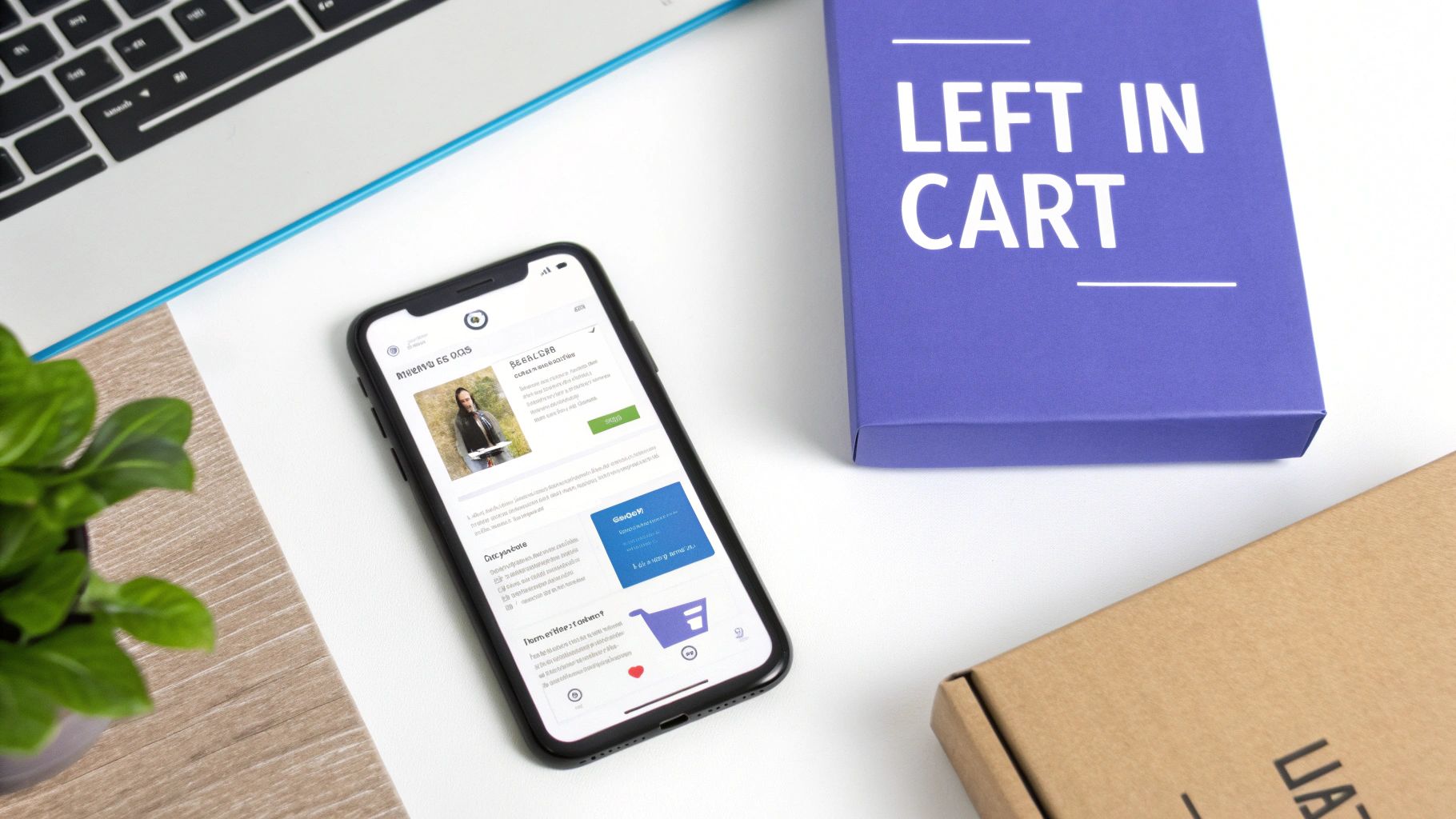
The single product reminder is the quintessential abandoned cart email. Its power lies in its simplicity and directness, focusing a customer's attention on the one item that captured their interest. This email typically features a large, high-quality image of the product, its name, price, and a prominent call-to-action (CTA) button that leads directly back to the checkout page.
This approach works best when a shopper abandons a cart with only one item. It removes the cognitive load of re-evaluating a multi-item cart and creates a frictionless path to purchase. Brands like Amazon and Target have perfected this technique, sending clean, uncluttered emails that serve as a gentle nudge, reminding the customer of their initial intent.
Strategic Breakdown
- When to Use It: Send this email within 1-3 hours of abandonment. It’s most effective for single-item carts, especially for lower to mid-priced products where the purchase decision is less complex.
- Why It Works: It re-engages customers with a highly personalized and relevant message, leveraging their recent browsing activity. The visual reminder re-ignites the initial desire for the product.
- Core Goal: To overcome minor distractions or hesitation and guide the user back to a pre-filled cart for a quick, seamless checkout.
Actionable Takeaways
To make your single product reminder one of the best abandoned cart email examples, implement these tactics:
- Use High-Quality Visuals: Display the product image prominently. If possible, show it from multiple angles or in a lifestyle context.
- Craft Benefit-Driven Copy: Instead of just saying "You left this in your cart," highlight a key benefit. For a pair of running shoes, you might say, "Your perfect run is waiting."
- Create Urgency (Sparingly): Consider adding a countdown timer if the item is low in stock or part of a limited-time offer to encourage immediate action.
- Analyze Your Audience: Understanding why shoppers abandon carts is crucial. Integrating insights from your social media analytics can reveal audience preferences and pain points, helping you tailor your email copy. Discover how to leverage social media for deeper customer insights and refine your e-commerce marketing strategy.
2. Multi-Product Cart Recovery Email
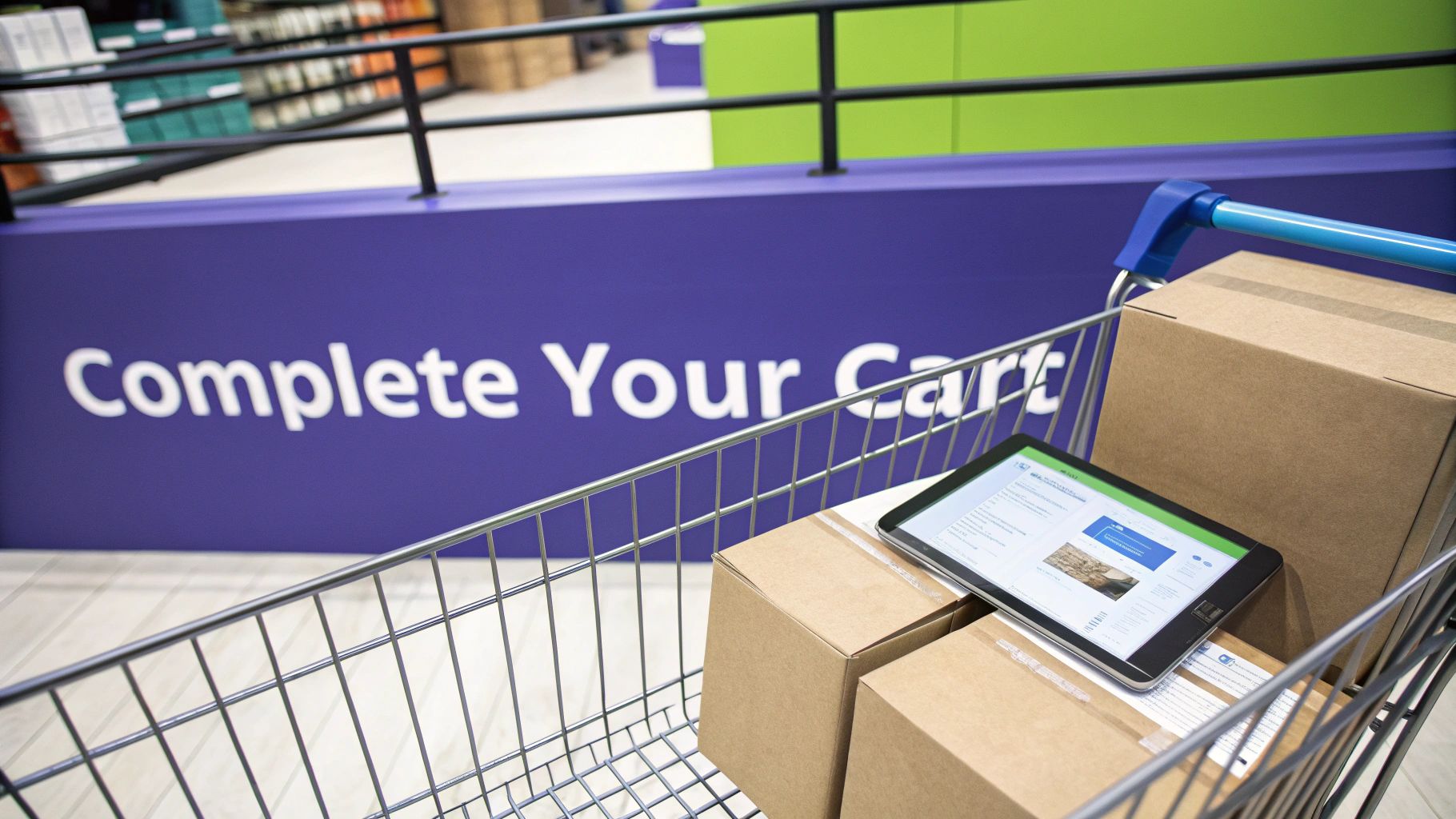
When a shopper leaves multiple items behind, the multi-product cart recovery email serves as a comprehensive reminder of their potential haul. Instead of focusing on a single product, this email showcases the entire collection of abandoned items, often in an organized grid or carousel format. This strategy reinforces the customer's original, larger purchase intent and highlights the value of the complete order.
Major retailers like ASOS and Urban Outfitters excel at this. They present the abandoned products as a curated collection, reminding the shopper of the look or set they were building. This transforms the email from a simple reminder into a personalized style suggestion, making the path back to purchase more compelling and visually appealing.
Strategic Breakdown
- When to Use It: Send this 3-6 hours after abandonment. It's ideal for carts with 2-8 items, where the total value is higher and the decision-making process might be more involved.
- Why It Works: It addresses the complexity of a multi-item cart by presenting all products clearly, preventing the customer from having to remember everything they selected. It also frames the items as a complete package, which can increase the perceived value and desirability.
- Core Goal: To reduce friction for high-intent shoppers with larger carts by providing a complete, visually organized summary of their selections and a direct link to finalize the purchase.
Actionable Takeaways
To create multi-product abandoned cart email examples that convert effectively, apply these strategies:
- Organize for Clarity: Display products in a clean grid or a swipeable carousel. To avoid overwhelming the user, limit the display to the top 6-8 items, arranging them by price or relevance.
- Incorporate Social Proof: Add elements like "Bestseller" tags, star ratings, or review counts directly on the product images. This builds trust and validates the customer's choices.
- Display Total Value: Clearly state the cart's subtotal. Seeing the full value can be a powerful motivator, especially if you later introduce a discount on the total order in a follow-up email.
- Use Consistent Product Cards: Ensure each product display has a consistent style, including the image, name, price, and quantity. This creates a professional and easy-to-scan layout.
3. Discount/Incentive-Driven Abandoned Cart Email
The discount-driven email is a classic, powerful persuasion tool used to convert price-sensitive shoppers. This strategy directly addresses one of the most common reasons for cart abandonment: unexpected costs. By offering a discount, free shipping, or another incentive, you give customers a compelling reason to complete their purchase immediately.
This approach goes beyond a simple reminder by adding a tangible value proposition. Brands like Sephora and Gap frequently use this tactic, sending emails that feature the abandoned items alongside a clear, enticing offer like "15% off to complete your order." This method is especially effective for turning hesitant browsers into first-time buyers and re-engaging customers who may have been comparison shopping.
Strategic Breakdown
- When to Use It: Send this email 24-48 hours after abandonment. This timing gives the customer a chance to reconsider on their own first, making the subsequent discount feel more impactful and less like an automatic, immediate offer. It's ideal for carts with mid to high-value items where price is a significant factor.
- Why It Works: It directly tackles price objections, which are a major hurdle in e-commerce. The added urgency of a limited-time offer motivates immediate action and can significantly increase conversion rates among shoppers who were on the fence.
- Core Goal: To overcome cost-related hesitation, create a sense of urgency, and provide an irresistible nudge that pushes the customer over the finish line.
Actionable Takeaways
To create high-converting discount-driven abandoned cart email examples, focus on these tactics:
- Offer Strategic Incentives: Don't just default to 10% off. Test different offers like a fixed dollar amount off, free shipping (often perceived as higher value), or a free gift with purchase. Analyze your product margins to determine what you can sustainably offer.
- Create Clear Urgency: Always include an expiration date for the discount, typically 24-72 hours. Use clear language like "Your 15% off code expires in 24 hours" and consider a dynamic countdown timer in the email to maximize impact.
- Personalize the Offer: Use dynamic, one-time-use discount codes (e.g., "WELCOME15-XYZ123") rather than generic codes. This makes the offer feel exclusive to the recipient and prevents it from being shared widely online, protecting your margins.
- Make It Easy to Apply: Ensure the discount code is prominently displayed and easy to copy. For an even better user experience, use a CTA link that automatically applies the discount to the customer's cart, removing any friction from the checkout process.
4. Customer Success/Value-Focused Abandoned Cart Email
Shifting the focus from "buy now" to "here's why you'll love it," the customer success or value-focused email is a consultative approach to cart recovery. Instead of solely pushing a sale, this email builds confidence by highlighting the tangible benefits, unique value, and transformative power of the products left behind. It addresses underlying customer hesitation by reinforcing the product's worth through social proof, educational content, and testimonials.
This strategy is particularly effective for high-consideration products, new innovations, or subscription services where the value proposition is more complex than a simple transaction. Brands like Patagonia and Skillshare excel at this, framing the abandoned item not just as a product but as an investment in a lifestyle, a skill, or a value system. They sell the outcome, not just the object.
Strategic Breakdown
- When to Use It: Send this email 24-48 hours after abandonment. It’s ideal for higher-priced items, technical products, or services where customers might need more conviction before committing.
- Why It Works: It tackles purchase anxiety head-on by providing validation and a deeper understanding of the product's benefits. By using authentic customer voices and case studies, it builds trust and helps shoppers envision the positive impact the product will have on their lives.
- Core Goal: To overcome customer hesitation by reinforcing the product's value, building trust through social proof, and educating the user on why their potential purchase is a smart decision.
Actionable Takeaways
To create a powerful, value-driven message that stands out among other abandoned cart email examples, try these tactics:
- Integrate Authentic Social Proof: Embed compelling customer quotes, star ratings, or short testimonials directly in the email. Instead of saying "customers love it," show them with a quote like, "This course changed my career path."
- Show, Don't Just Tell: Link to video testimonials, detailed case studies, or blog posts that demonstrate the product in action. An unboxing video or a tutorial can demystify a complex item and make its benefits feel more real.
- Focus on Transformation: Frame your copy around the "before and after." For a skincare product, you might say, "Join thousands who unlocked brighter, healthier skin." For a software tool, "See how [Customer Name] saved 10 hours a week."
- Highlight Unique Value: Clearly articulate what makes your product different. Use a small bulleted list to compare features or emphasize a core differentiator, such as sustainable sourcing or a proprietary technology, to justify the investment.
5. Social Proof/Urgency-Based Abandoned Cart Email
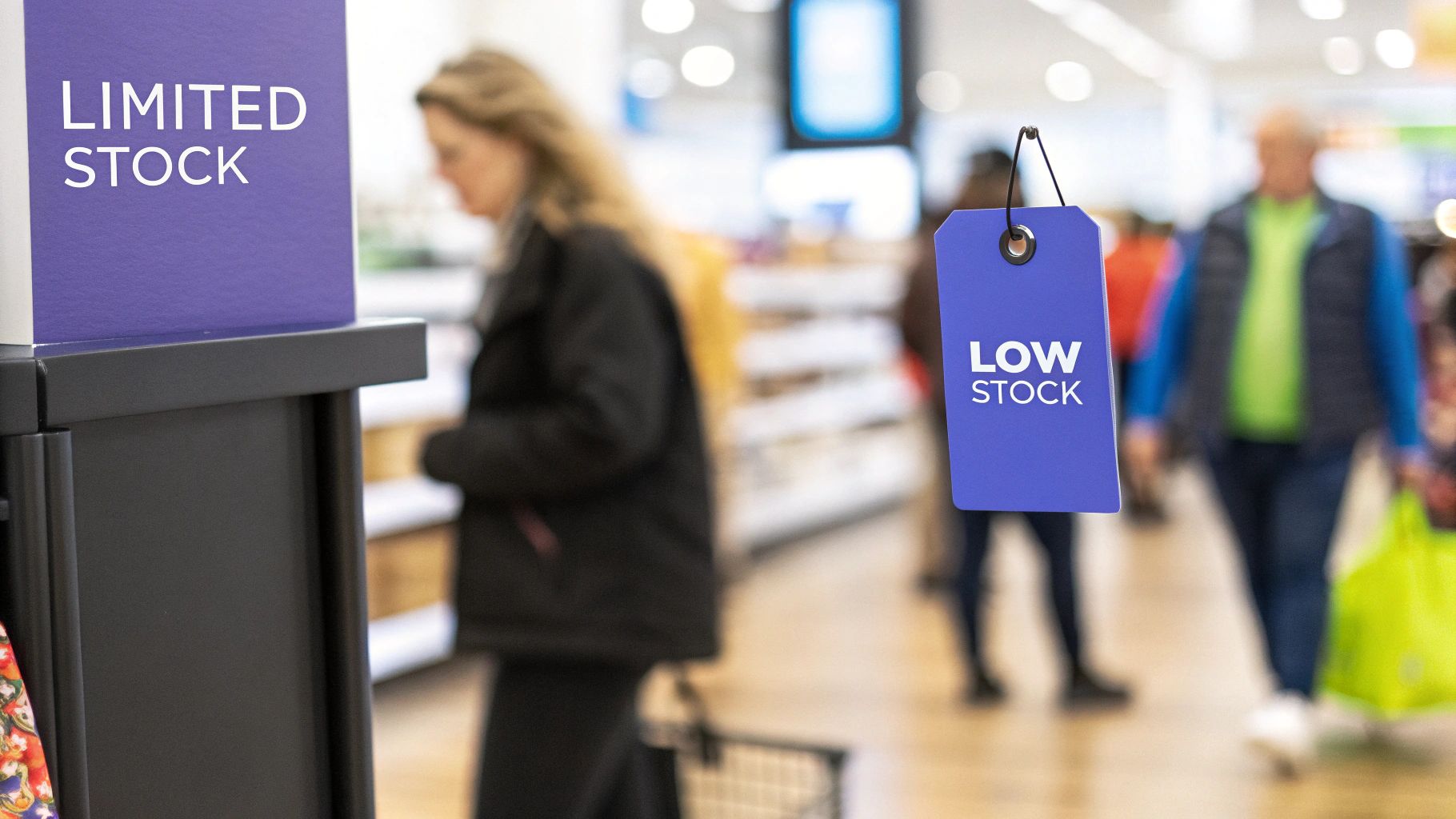
The social proof and urgency-based abandoned cart email taps into powerful psychological triggers like Fear of Missing Out (FOMO) and the principle of social validation. Instead of offering a discount, this strategy highlights the item's popularity and scarcity to motivate customers to complete their purchase before the opportunity is lost. It leverages data to show that others desire the product, making it seem more valuable and urgent to acquire.
This approach is highly effective because it shifts the focus from price to demand. Brands like Booking.com excel at this by showing messages like "Only 2 rooms left," while fashion retailers might use "Low Stock" or "Selling Fast!" labels. These notifications create a compelling reason to act now, transforming hesitation into a decisive purchase.
Strategic Breakdown
- When to Use It: Send this email within 4-6 hours of abandonment. It’s perfect for trending products, items with limited inventory, or seasonal bestsellers where scarcity is a genuine factor.
- Why It Works: It leverages social proof (popularity) and scarcity (limited availability) to increase the perceived value of the item. FOMO is a strong motivator that encourages immediate action without eroding profit margins with discounts.
- Core Goal: To create a sense of urgency and desirability around the abandoned item, compelling the user to purchase based on potential loss rather than a price reduction.
Actionable Takeaways
To create high-converting social proof abandoned cart email examples, implement these tactics:
- Integrate Dynamic Data: Use real-time metrics in your email copy. Phrases like "Over 50 people have bought this today" or "Only 3 left in your size" are far more impactful than generic statements.
- Showcase Customer Ratings: Display star ratings and the number of reviews prominently near the product image. For example, "Join 1,200+ happy customers who rated this 4.8 stars."
- Ensure Authenticity: The urgency you create must be real. Falsely claiming low stock can damage customer trust. Use accurate inventory and sales data to maintain credibility.
- Test Messaging Intensity: A/B test different levels of urgency. Compare "This item is popular" against a more direct "This item is selling out fast." Analyze which message resonates best with your audience without causing anxiety.
6. Personalized Recommendation Abandoned Cart Email
This advanced email goes beyond a simple reminder by combining the abandoned item with AI-powered, personalized product recommendations. It aims not only to recover the initial sale but also to increase the average order value (AOV) by suggesting other products the customer might love based on their browsing history, past purchases, and user segmentation data.
This strategy transforms a potential lost sale into an opportunity for upselling and cross-selling. Brands like Amazon excel at this, showing "Frequently bought together" or "Customers who viewed this also viewed" items directly within the abandoned cart email. It’s a powerful way to show you understand the customer's needs and tastes, making the email feel less like a hard sell and more like a helpful, curated shopping experience.
Strategic Breakdown
- When to Use It: Send this 24-48 hours after abandonment, as part of a multi-email sequence. It's ideal for customers who have previously purchased or have a rich browsing history on your site, as this provides the data needed for accurate recommendations.
- Why It Works: It re-engages the customer with their original item while also presenting fresh, relevant options that might be an even better fit or a perfect add-on. This approach can overcome the initial hesitation by offering compelling alternatives or complementary products, boosting both conversion rates and cart value.
- Core Goal: To recover the abandoned cart while simultaneously increasing the potential transaction size by showcasing other highly relevant products the user is likely to purchase.
Actionable Takeaways
To create one of the most effective personalized recommendation abandoned cart email examples, implement these strategies:
- Balance Your Layout: Feature the primary abandoned item prominently, but dedicate a clean, visually appealing section below it for 2-3 recommended products. Don’t overwhelm the user with too many choices.
- Leverage Dynamic Content: Use dynamic content blocks that automatically populate with different product recommendations based on the recipient's specific segment or behavior. This ensures maximum relevance for every individual.
- Segment for Accuracy: Create customer segments based on purchase history (e.g., "first-time buyers," "VIP customers") and browsing patterns (e.g., "viewed category X"). Tailor the recommendation algorithm to each segment for better accuracy.
- Test Your Recommendations: Continuously A/B test your recommendation logic. Do customers respond better to "similar items," "complementary items," or "best-sellers"? Track click-through and conversion rates on the recommended products to refine your approach.
7. Win-Back/Emotional Appeal Abandoned Cart Email
Sometimes, a purchase decision isn't just about price or features; it's about a feeling. The win-back or emotional appeal email steps away from aggressive sales tactics and focuses on building a deeper connection. This strategy uses storytelling, brand mission, and empathy to gently remind shoppers why they were interested in the first place, aligning the purchase with their values.
This approach is particularly effective for mission-driven brands or those with a unique story. Instead of a direct "Buy Now" message, it frames the completion of a purchase as joining a community or supporting a cause. Brands like TOMS, which highlights its "one for one" giving model, or Allbirds, which focuses on sustainability, use this narrative to transform a simple transaction into a meaningful action.
Strategic Breakdown
- When to Use It: Send this email 24-48 hours after abandonment. It's best used as a second or third email in a sequence, after a more direct reminder hasn't converted. It works exceptionally well for brands with strong ethical, environmental, or community-focused identities.
- Why It Works: It taps into higher-level motivations beyond the product itself. By creating an emotional resonance, it builds brand loyalty and can overcome hesitation rooted in price sensitivity or indecision, making customers feel good about their purchase.
- Core Goal: To reconnect with the customer on a personal level, reinforcing the brand's value proposition and mission to make the abandoned item feel like more than just a product, but a part of a larger, positive story.
Actionable Takeaways
To create win-back messages that stand out among abandoned cart email examples, implement these tactics:
- Humanize Your Brand: Use a personal tone, perhaps from the founder or a team member. Share a brief story about your brand's mission or the impact of a purchase.
- Connect Product to Purpose: Clearly articulate how the abandoned item connects to your brand's mission. For an eco-friendly backpack, you might say, "This bag isn't just for your adventures; it helps protect them too."
- Use Authentic Imagery: Feature behind-the-scenes photos, pictures of your team, or images showing your brand's impact in the real world instead of standard product shots.
- Refine Your Narrative: The stories you tell in your emails should be consistent with your broader marketing. Mastering how to weave your brand story into short-form content is key. You can discover powerful techniques by exploring effective copywriting for social media.
8. Sequential/Multi-Touch Abandoned Cart Campaign
A single email isn't always enough to convert a hesitant shopper. The sequential or multi-touch abandoned cart campaign addresses this by deploying a strategic series of emails over several days. Each email in the sequence adopts a different angle, from a gentle reminder to a compelling incentive, creating multiple opportunities to re-engage the customer without being repetitive.
This sophisticated approach recognizes that shopper hesitation varies. Some customers need a simple nudge, while others require a stronger value proposition or a sense of urgency. Brands like Shopify and Klaviyo champion these automated workflows, allowing e-commerce stores to build progressive recovery campaigns that escalate their message and offers over time, systematically guiding users back to the checkout.
Strategic Breakdown
- When to Use It: Ideal for almost any e-commerce business, especially those with higher-priced items or a longer consideration phase. The sequence should begin within 1-3 hours of abandonment, with follow-up emails spaced 24-48 hours apart.
- Why It Works: It caters to different stages of the customer's decision-making process. By varying the message, you can address multiple potential objections (price, distraction, uncertainty) and increase the probability of conversion across a wider audience segment.
- Core Goal: To create a persistent yet respectful re-engagement journey that nurtures the customer back to purchase by testing different psychological triggers like helpfulness, value, and urgency.
Actionable Takeaways
To build one of the most effective abandoned cart email examples using a sequence, follow these steps:
- Design a Logical Flow: Structure your campaign logically. Start with a simple reminder (Email 1), introduce a value-add like a discount or free shipping (Email 2), and create urgency with a final offer or low-stock alert (Email 3). To design a truly effective multi-touch abandoned cart campaign, consider leveraging proven email sequence templates for structured communication.
- Vary Subject Lines and Content: Avoid inbox fatigue by changing the subject line and core message of each email. This makes each touchpoint feel fresh and increases open rates.
- Set Clear Exit Triggers: Ensure your automation removes a customer from the sequence immediately after they make a purchase. This prevents sending irrelevant or annoying emails and maintains a positive customer experience.
- Integrate into a Broader Strategy: A cart recovery sequence is a powerful tool within a larger customer journey. Understanding how to create a marketing campaign helps you align your email efforts with other touchpoints like social media retargeting for a cohesive brand message.
8-Type Abandoned Cart Email Comparison
| Template | Implementation Complexity 🔄 | Resource Requirements ⚡ | Expected Outcomes 📊 | Ideal Use Cases 💡 | Key Advantages ⭐ |
|---|---|---|---|---|---|
| Single Product Reminder Email | Low 🔄 — single-item layout, minimal logic | Low ⚡ — one image + CTA | High CTR for impulse buys ⭐ 📊 | Small orders; solo sellers; impulse purchases | Simple; fast to deploy; easy to A/B test |
| Multi-Product Cart Recovery Email | Medium 🔄 — grid/carousel, responsive design | Medium ⚡ — multiple images, layout work | Good recovery for higher AOV ⭐⭐ 📊 | Multi-item carts; cross-sell scenarios; retailers | Shows total value; supports cross-sell visibility |
| Discount/Incentive-Driven Abandoned Cart Email | Low–Medium 🔄 — promo placement + code logic | Low–Medium ⚡ — promo assets, code tracking | Very high conversions for price-sensitive buyers ⭐⭐⭐ 📊 | Seasonal promos; price-sensitive audiences; acquisition | Drives quick conversions; easy ROI tracking |
| Customer Success/Value-Focused Abandoned Cart Email | Medium–High 🔄 — content-rich, testimonial placement | High ⚡ — content creation, testimonials, media | Builds trust; better for premium/complex buys ⭐⭐ 📊 | Premium products; unfamiliar categories; high-consideration items | Addresses objections; strengthens brand credibility |
| Social Proof/Urgency-Based Abandoned Cart Email | Medium 🔄 — real-time badges & dynamic metrics | Medium ⚡ — inventory/review integrations | Good conversions without discount; preserves margins ⭐⭐ 📊 | Trending items; limited-stock situations; high-volume stores | Creates FOMO; maintains pricing integrity |
| Personalized Recommendation Abandoned Cart Email | High 🔄 — AI recommendations & dynamic blocks | High ⚡ — data infra, testing, personalization tools | Increases AOV and relevance significantly ⭐⭐⭐ 📊 | Large catalogs; data-rich enterprises; advanced marketers | Highly personalized UX; upsell/cross-sell lift |
| Win-Back/Emotional Appeal Abandoned Cart Email | Medium 🔄 — narrative flow, brand voice control | Medium–High ⚡ — storytelling assets, creative time | Improves loyalty; moderate immediate recovery ⭐ 📊 | Purpose-driven brands; lifestyle/premium merchants | Deepens emotional connection; differentiates brand |
| Sequential/Multi-Touch Abandoned Cart Campaign | High 🔄 — automation, multi-channel logic | High ⚡ — multiple assets, channels, monitoring | Highest overall conversion over time ⭐⭐⭐ 📊 | Mature email programs; agencies; enterprises | Multi-touch lift; better testing & journey mapping |
Putting It All Together: Building Your Unbeatable Cart Recovery Engine
We've journeyed through a comprehensive gallery of high-impact abandoned cart email examples, dissecting everything from simple reminders to complex, emotionally-driven win-back campaigns. The power isn't in any single template, but in understanding the strategic "why" behind each one. Your goal is not merely to copy and paste but to construct a sophisticated, automated system that speaks directly to your customer's hesitation at the moment it happens.
The difference between a generic, low-performing cart email and a true revenue recovery engine lies in thoughtful execution. It's about recognizing that a customer who abandoned a single high-consideration item needs a different message than someone who left a cart full of low-cost consumables. This is where strategy transforms into sales.
From Examples to a System: Your Actionable Roadmap
Viewing these examples should inspire you to build a cohesive, multi-touch sequence. A scattered, one-off email might recover a few sales, but a deliberate campaign builds momentum and addresses different psychological barriers over time.
Here is a practical framework to transition from inspiration to implementation:
Map Your Core Sequence: Don't try to do everything at once. Start with a foundational 3-step flow.
- Email 1 (1-4 hours post-abandonment): Deploy the Simple Reminder. It’s low-pressure, helpful, and incredibly effective at catching customers who were simply distracted.
- Email 2 (24 hours post-abandonment): Introduce Value and Social Proof. Remind them why they wanted the product. Use customer testimonials, star ratings, or user-generated content to build confidence and overcome uncertainty.
- Email 3 (48-72 hours post-abandonment): Present a Strategic Incentive. This is your final nudge. Whether it's a 10% discount or free shipping, make it a compelling reason to act now. Reserve your best offers for this final touchpoint to protect your margins.
Segment and Personalize: The most advanced strategies we explored, like personalized recommendations, hinge on segmentation. You can begin with simple segments:
- New vs. Returning Customers: Offer a slightly richer discount to new customers to secure that crucial first conversion.
- Cart Value: Carts over a certain threshold (e.g., $150) might trigger a more personalized, value-focused email, while lower-value carts receive the standard sequence.
- Product Category: A customer abandoning a complex electronic device may benefit from an email highlighting key features or linking to a setup guide, a different approach than for someone buying apparel.
The True Value of a Mastered Cart Recovery Strategy
Mastering your abandoned cart email strategy is about more than just clawing back lost revenue; it’s a critical component of the customer experience. A well-crafted email demonstrates that you're paying attention and value their interest. It’s an opportunity to reinforce your brand voice, build trust, and turn a moment of friction into a moment of connection.
By implementing the tactics from these abandoned cart email examples, you are not just sending emails. You are building a resilient, automated sales assistant that works 24/7 to strengthen customer relationships and protect your bottom line. Each recovered cart is a testament to a system that understands customer psychology and responds with the perfect message at the perfect time. Stop leaving money on the table and start turning hesitation into conversion.
Ready to automate your social media promotions alongside your email campaigns? While you're busy building the perfect cart recovery sequence, PostSyncer can handle scheduling and publishing your product announcements, user-generated content, and promotional offers across all your social platforms. Create a seamless customer journey from social discovery to a completed purchase with PostSyncer.